



Developing a Method for Quantitative Monitoring of Algal Bloom Using Lake Surface Images
In closed water bodies where water exchange is limited, such as lakes and dam reservoirs, the discharge of nutrients from the watershed can lead to an environment with a higher algal bloom likelihood of the mass development of phytoplankton, called algal bloom. This algal bloom causes discoloration of lake water and also causes a stench with the death of plankton. Also, toxic plankton can cause the death of aquatic organisms.Due to rising water temperatures driven by climate change in recent years, the environment will become increasingly conductive to algal bloom, necessitating methods for long-term, regular monitoring. With conventional monitoring, algal bloom levels are determined through visual inspection, but this method is not quantitative, and it relies on the sense and experience of experts. Therefore, in this study, we have developed a monitoring method that is simple and quantitative.
The outline of the method is as follows. First, we photograph the lake surface using a digital camera and then extract the RGB components from the images. RGB represents the intensity of three monochromatic lights with wavelengths of R: 700 nm (red), G: 546.1 nm (green), and B: 435.8 nm (blue), expressed as bit values ranging from 0 to 255. The closer to 0, the darker; the closer to 255, the closer to a primary color. For example, the values of (R, G, B) = (0, 0, 0) represent black; the values of (R, G, B) = (255, 255, 255) represent white; and the values (R, G, B) = (255, 255 ,0) represent yellow. Next, we converted the RGB bit signals into luminance in order to calculate the spectral reflection factor of wavelengths of R: 700 nm, G: 546.1 nm, and B: 435.8 nm based on the solar radiation illuminance at the time of photography (calculated from the latitude and longitude of the shooting location and time). In addition, we collected lake water at the time of photography and analyzed the concentration of photosynthetic pigments (chlorophyll a) in its phytoplankton in order to examine and create a formula expressing the relationship between the spectral reflection factor and the concentration of chlorophyll a. Ultimately, we used the spectral reflection factor of 700 nm and 546.1 nm only in the relational formula (Figure 1).
Additionally, we set the algal bloom from 0 to 7 according to the extent of the chlorophyll a concentration (Figure 1), and we also performed filtering for a visual determination of the algal bloom level. (Figure 2) shows the results. It shows that the algal bloom levels express even subtle color differences that are difficult for the human eye to perceive. Based on these results, we identified the threshold for the algal bloom level, succeeding in visually determining the algal bloom level. We will improve the tool so that it can quantitatively determine algal bloom levels by changing their thresholds as appropriate and bringing them closer to the results of conventional visual inspections.
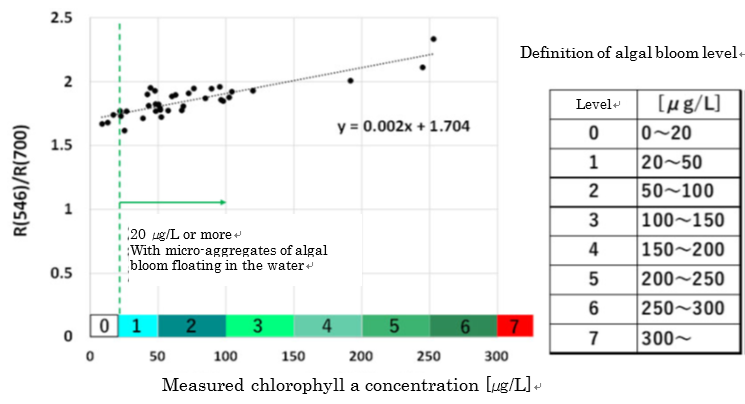
Relationship between the reflectance of spectral components extracted from digital camera images
and the concentration of phytoplankton photosynthetic pigment (chlorophyll a) components, and setting of the algal bloom level according to chlorophyll a concentration
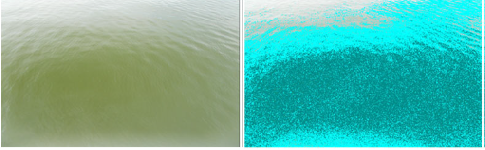
Filtering for determining the algal bloom level
(Left: Original image. Right: Image after filtering,
chlorophyll a concentration: 50.4 μg/L, algal bloom level: 2.)
(Contact : Water Quality Research Team)
Observation of Asphalt Deterioration Using Advanced Measurement
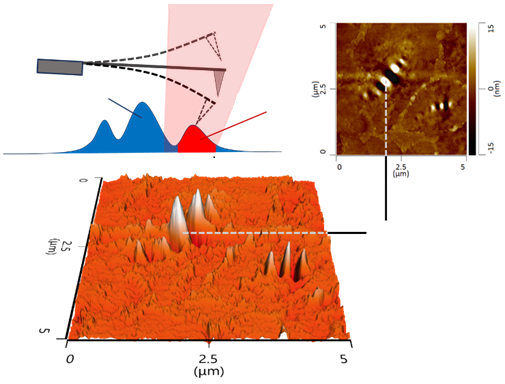
Figure 1
AFM-IR principle and measurement
example of topographic asphalt image
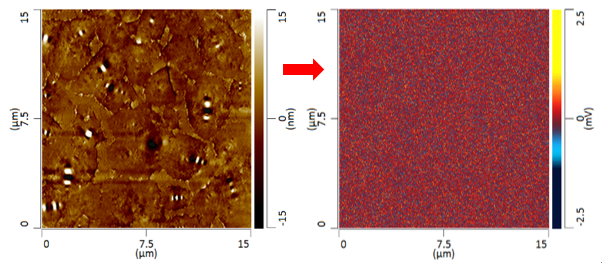
Figure 2
Topographic image of healthy asphalt,
left,and IR image (1,690 -1), right
※No changes are observed in the
IR image in the new asphalt.
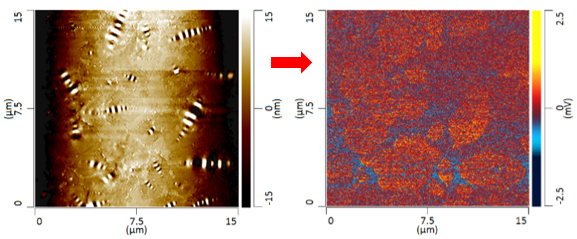
Figure 3
Topographic image of deteriorated asphalt,
left, and IR image (1,690cm-1), right
※The IR image shows that specific components
are concentrated in specific areas.
The Materials and Resources Research Group at PWRI has introduced a new observation device, the AFM-IR, which combines a microscope that enables three-dimensional observation of very small objects invisible to the naked eye with a device that uses light to examine material properties. Using this device is useful for research aiming to improve the efficiency of asphalt pavement recycling. In this article, we introduce the mechanism of this device and give an actual example of how it is used to observe the deterioration of asphalt.
The AFM-IR examines the surface of asphalt by tracing it in order to capture its unevenness in three dimensions. Simultaneously, it also uses infrared light to identify the differences among the components that make up asphalt. In other words, it has the ability to examine both the shape and the components simultaneously. When we actually observed the asphalt, we found bee-like stripes that originated from the wax components (Figure 1).
We also used the device to examine the deterioration. While there were no particular changes observed in the new asphalt (Figure 2), in the artificially deteriorated asphalt, we found that specific components were concentrated around the patterns (Figure 3). This indicates that deterioration spreads from the patterned areas or nearby areas. These results provide a detailed understanding of how the components change as the asphalt deteriorates.
The advantage of this device is that it makes it possible to observe deterioration and component distribution quickly, even from a very small sample. It can be applied not only to asphalt but also to resins, paints, and a variety of other materials used in construction. We will use this device in combination with existing evaluation methods to help extend the lifespan of roads, bridges, and other forms of infrastructure.
(Contact : Innovative Materials and Resources Research Center Materials and Resources Research Group)
Development of a Photogrammetry-Based Technology for Measuring Material Loss in Pavement Cracks
Digital elevation model
generated using photogrammetry
The generated high-density point cloud
Surface width of cracks
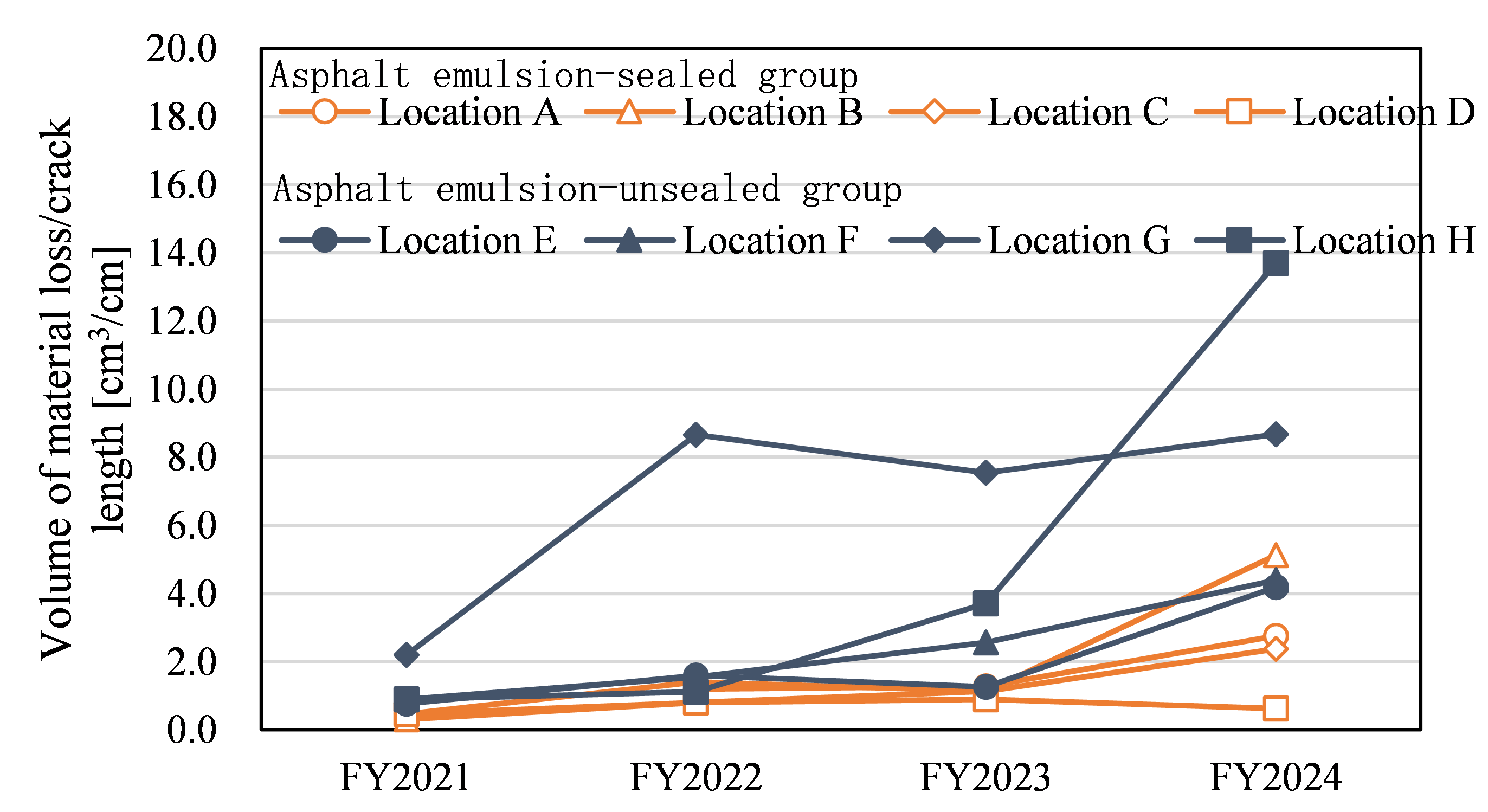
Volume of material loss per unit crack length
1. Introduction
In snowy and cold regions, water infiltrates pavement cracks and repeatedly freezes and thaws during the spring thaw, which causes loss of asphalt mixture along the cracks because the asphalt at the surface edges along the cracks tends to chip off. Delamination between asphalt layers also occurs, and potholes form. To prevent pothole formation, an effective method is to reduce water intrusion by sealing the cracks with an asphalt emulsion. However, techniques for measuring the effectiveness of this emulsified asphalt sealing have not yet been established.
The Cold-region Road Maintenance Team has been studying methods to measure and assess material loss in the pavement cracks by photogrammetry. This article introduces our efforts in this study.
2. Measurement and evaluation at the test site
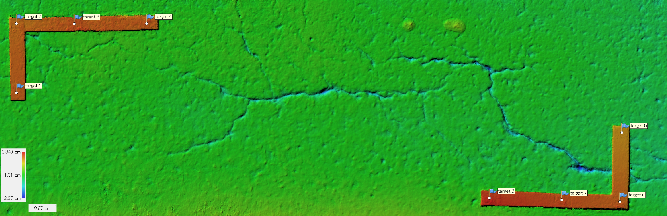
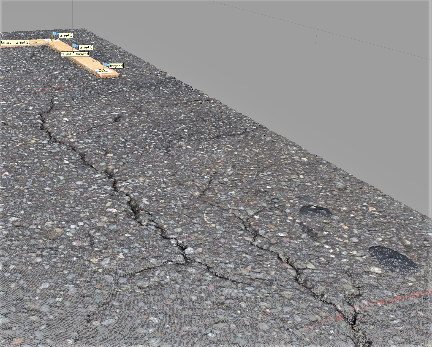
This study was conducted on the national highway in Hokkaido, Japan, where cracks had been sealed with asphalt emulsion to prevent potholes. We took multiple photos of the pavement cracks and used structure-from-motion (SfM) processing software to create a digital elevation model (a model that expresses the elevations of road surface as digital data) and a high-density point cloud (a set of points with X, Y, and Z coordinates)(Figures 1 and 2) .
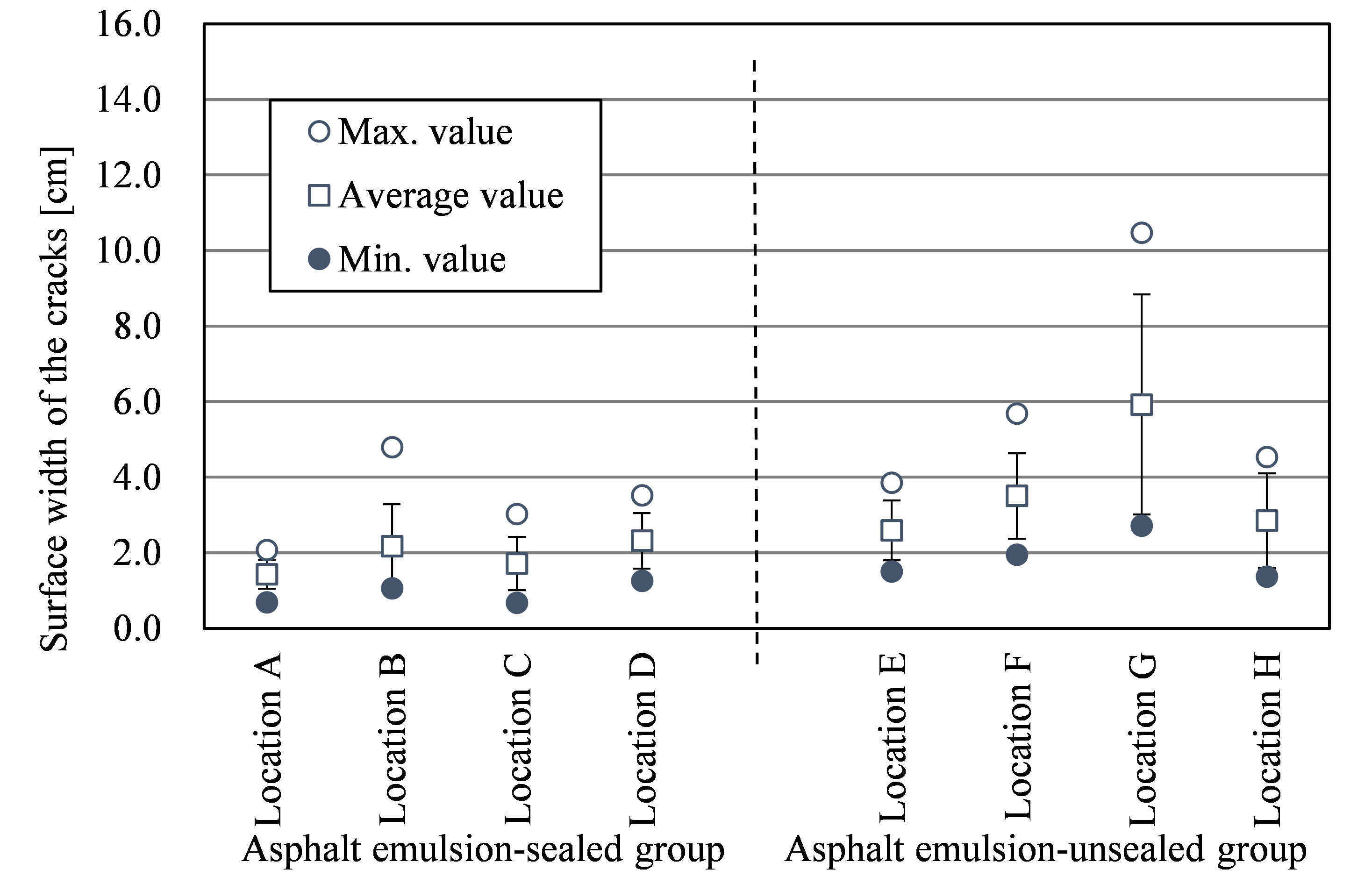
Using this model, we measured the surface width of the cracks and the volume of missing material. The material loss was found to be less in the sealed sections than in the unsealed sections (Figure 3). We also found that asphalt emulsion effectively controlled material loss for several years (Figure 4).
Quantifying material loss helps determine the appropriate timing for pavement repair. We expect this technology to contribute to more effective pothole prevention.
(Contact : Road Maintenance Research Team,CERI)
Development of AI-Based Ice Jam Detection Technology
In cold regions of Japan such as Hokkaido, many rivers freeze during winter, and river ice forms in the river channel. In early spring, as temperatures rise, the ice melts, breaks apart, and flows downstream. This flowing ice can accumulate at narrow sections of the river, among other places, leading to a phenomenon known as an ice jam.
Ice jams can cause sudden rises in river water levels, flooding, and water intake disruptions due to inlet blockage. These pose significant challenges for river disaster prevention and maintenance(Photos 1 and 2).
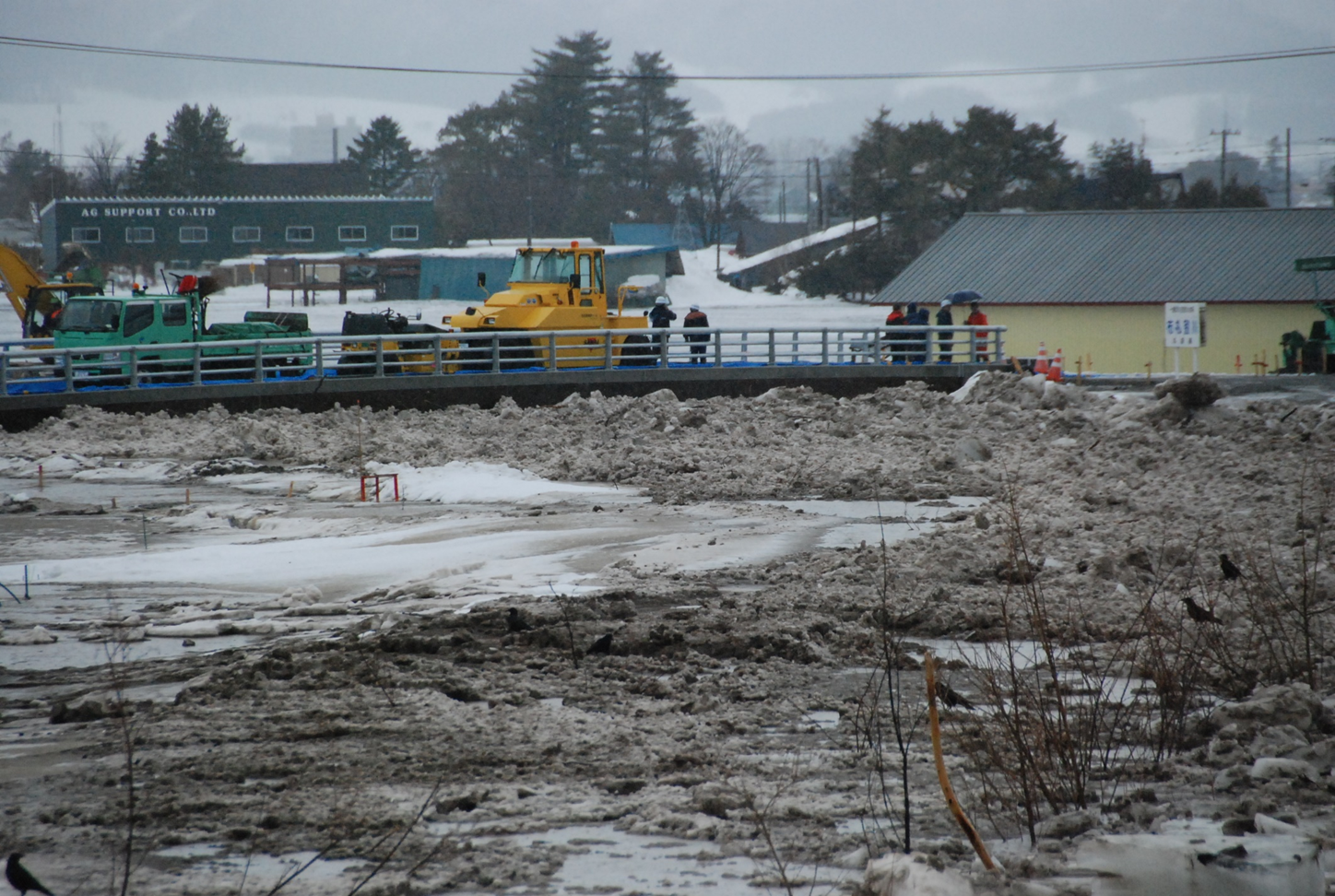
Photo 1
An ice jam on the Furebetsu River caused flood damage.
(March 2018, credit: Furano City)
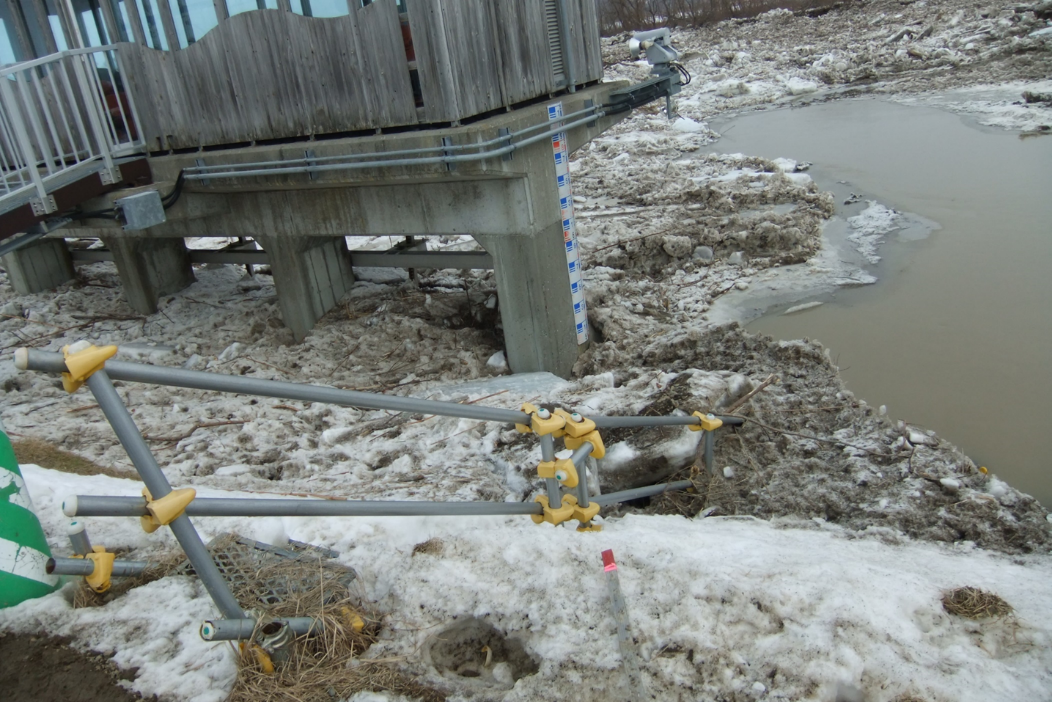
Photo 2
River ice accumulated near a sluice gate due to an ice jam.
(March 2018, credit: Hokkaido Regional Development Bureau)
To address this, the River Engineering Research Team has been working on developing a model that monitors ice jam occurrences using CCTV camera footage and water level data provided by the Hokkaido Regional Development Bureau. This model aims to enable efficient and effective river management of ice-covered rivers.
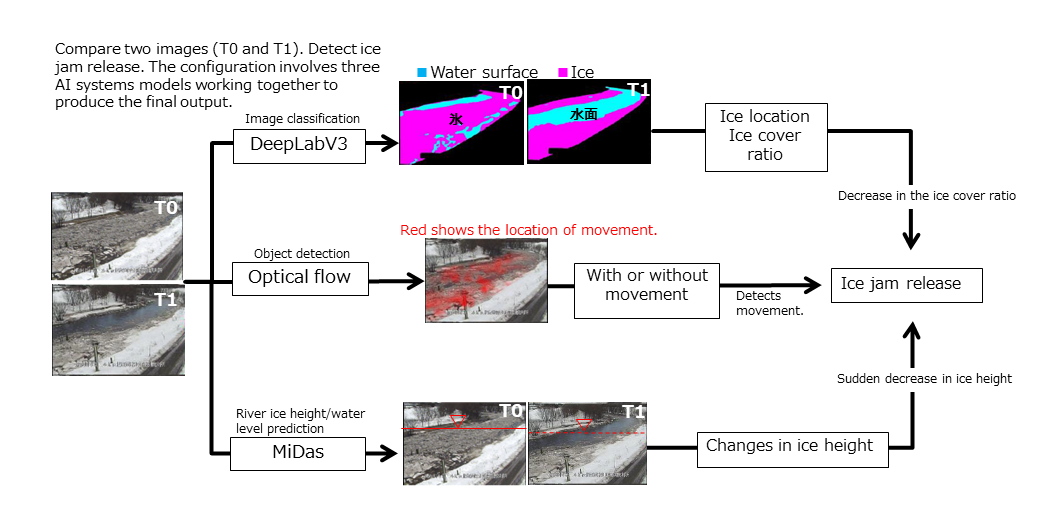
The model utilizes AI-based image analysis of CCTV footage to automatically detect ice jams and issue alerts. The model consists of three AIs that respectively perform: image classification, object detection, and river ice height/water level prediction. Image classification determines differences in the ice cover ratio between two images. Object detection determines whether the river ice is moving or stationary. River ice height/water level prediction extracts changes in ice height and water levels during an ice jam event. Based on the combined results of these three models, the system comprehensively judges on whether an ice jam is occurring (Figure 1). To train the model, 50 images of actual ice jams were used, along with more than 400 AI-generated images.
To support practical use by river administrators, the system integrates the image detection model with a program that monitors water level rises from existing observation stations set up by the Hokkaido Regional Development Bureau. This combined system allows for the more reliable detection of ice jams and is undergoing trial operation by the bureau.
While the current model detects ice jams in real time, our ultimate goal is to predict their occurrence. This would allow for safer in-channel work operations and more effective disaster risk management during winter.
To this end, we plan to further accumulate and analyze meteorological, water level, and river ice data observed during ice jam events. Using the accumulated data, we aim to develop a prediction model that incorporates meteorological inputs, such as air temperature and rainfall, and river channel topographic data, including riverbed gradients, to assess when and where ice jams are likely to occur. Through these efforts, we strive to contribute to more efficient and effective river management in cold regions.
(Contact : River Engineering Research Team,CERI)