



Development of Delineation Guidance Devices for Snowplow Operators
When a snowplow is driven or snow removal operations are performed, visibility can be severely impaired by blizzards. Furthermore, road delineation features—such as road edges, centerlines, and guardrails—often become obscured by snow cover or roadside snowbanks. Under these conditions, operators face increased risks of veering off the road, straying into oncoming lanes, or colliding with roadside structures. To mitigate these risks, delineation guidance facilities such as arrow markers and snow poles(Photo 1)are installed to help operators and other drivers identify the positions of road edges and guardrails. However, the effectiveness of these facilities is limited to their specific installation locations, and deploying them along entire road networks is unfeasible due to cost and labor constraints. To address this, we are developing ‘delineation guidance equipment’(Photo 2)that utilizes light emitted from the vehicle itself to indicate the position of road edges and other features, providing continuous delineation guidance while the vehicle is in motion.
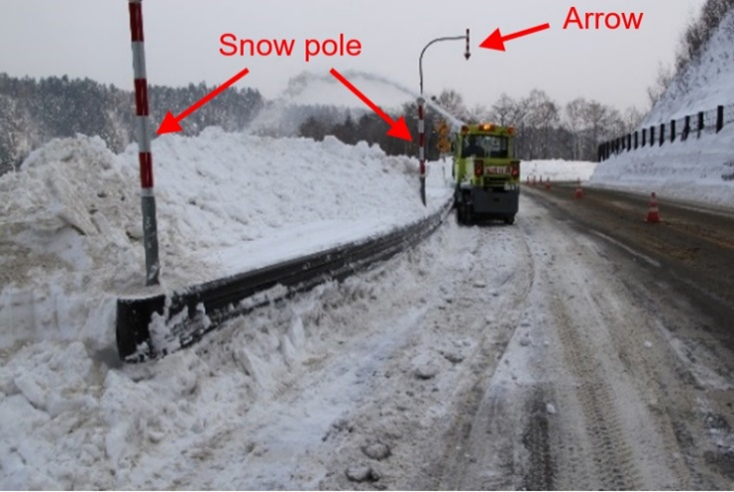
Arrow and snow pole |
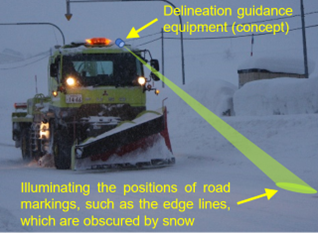
Concept of the delineation guidance equipment mounted on a snowplow |
This equipment consists of a lighting unit that emits highly directional light, an electric roll unit that directs the beam, a control computer that calculates the roll unit’s movements, and a GNSS system that accurately determines the vehicle’s position. The narrow-beam light is projected toward target positions (such as road edges) that have been pre-measured using the GNSS. The control computer calculates the required illumination direction based on the vehicle’s current position and adjusts the motorized roll unit accordingly to control the lighting device’s orientation. A key feature of this system is its ability to provide delineation guidance without requiring new roadside infrastructure, achieved by combining GNSS positioning data with a highly directional light beam.
The device is currently in the prototype stage (Photo 3), and basic operations have been successfully achieved. These include tracking targets by automatically turning the lights on when a target position is detected and turning them off when the vehicle moves out of the target’s range. Regarding illumination accuracy, there is currently a deviation of several tens of centimeters from the actual target position, which can exceed 1 meter in some cases. Several challenges remain before practical implementation can be achieved; therefore, we plan to continue development with the aim of improving accuracy and operational stability, ultimately establishing a technology that enhances safety during winter road snow removal operations.
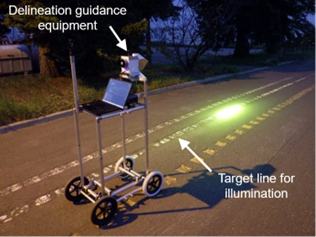
The prototype delineation guidance system during an operation test |
(Contact: Civil Engineering Research Institute for Cold Region Machinery Technology Research Team)
Reuse of Discarded Fishing Nets for Reinforcing Concrete
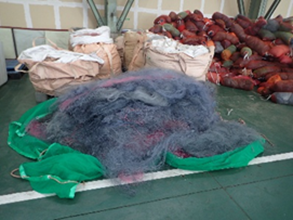
Photo 1:
Discarded fishing nets
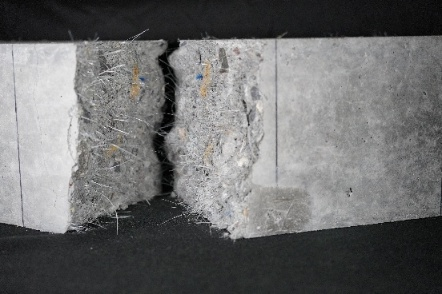
Photo 2:
Shear surfaces of
a concrete specimen
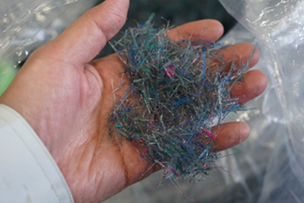
Photo 3:
Shredded fishing net fibers
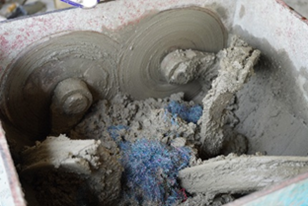
Photo 4:
Mixing fish net concrete
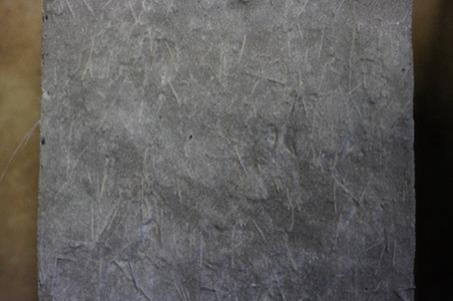
Photo 5:
The upper surface of a specimen
This study aims to establish a technology for utilizing discarded fishing nets (Photo 1), which are frequently generated in Hokkaido and are rarely reused, as a source of fibers for reinforcing concrete¹). The SDGs for environmental conservation and the Hokkaido Port and Fishing Harbor Technology Development Vision²) both identify “promoting carbon neutrality in Hokkaido’s coastal areas and conserving the marine environment” as priority issues. Within this framework, technology to reinforce concrete by incorporating materials from discarded fishing nets has been specifically designated for development.
To address this challenge, we first examined how to process fishing nets to achieve certain shapes of fibers and we conducted lab tests to verify whether cutting and sieving could achieve fibers of consistent quality. Furthermore, we produced prototype concrete mixed with these fishing net fibers(Photo 2)and evaluated its basic performance, including workability, strength, and durability, in order to assess the potential of this technology in terms of achieving effective waste materials utilization and environmental impact reductions.
To evaluate the material properties of concrete when fibers from finely chopped fishing nets are mixed in(Photos 3 and 4), various performance tests were conducted. Although the source nets varied in length and thickness, refining the cutting process was found to allow for a certain degree of control over the fiber length. Testing verified that while adding the fibers caused a slight decrease in slump (a measure of fresh concrete’s workability), it significantly improved crack resistance and maintained sufficient durability against freeze-thaw cycles.
However, some construction challenges were identified, such as fibers tending to protrude from the concrete surface, highlighting the critical importance of fiber shape control(Photo 5).
To develop this as a viable technology for actual job sites, strict control over fiber length and shape is essential. Excessively long fibers do not disperse uniformly during mixing, which degrades workability; therefore, sorting and grading the fibers prior to mixing is crucial. While tests confirmed that the fibers effectively suppress cracking and improve ductility, suggesting the potential to extend maintenance intervals, their effects on compressive strength and air content were found to vary depending on the fiber conditions. Consequently, more data is necessary to optimize fiber specifications. Quantifying the precise crack-suppression mechanisms remains an important objective for future research.
[References]
1) Nobuhiro Sugimori, Kazuya Hase, Takeshi Ishizawa: Characteristics of Fiber Reinforced Concrete Using Waste Fishing Nets and Identification of Challenges in Quality Control, Monthly Report of the Civil Engineering Research Institute for Cold Region No. 873, pp. 35 -41, September 2025.
2) Port and Harbor Construction Section and Fisheries Section, Hokkaido Regional Development Bureau: Visions for Technological Development for Harbors and Fishing Ports in Hokkaido -- Declaration on Technological Development for Creating a Sustainable Northern Ports, 2021.
https://www.hkd.mlit.go.jp/ky/kk/kou_ken/ud49g7000000jypy.html
(As of April 24, 2026)
(Contact: Civil Engineering Research Institute for Cold Region Port and Coast Research Team)