



Building a Flood Prediction System for Overseas River Basins
ICHARM has collaborated with the Global Environment Data Commons at the University of Tokyo to develop a flood prediction system for river basins in foreign countries. In developing regions like Southeast Asia and South Asia, there are many countries that still lack a quantitative precipitation forecast or flood prediction system. Once a heavy rain event occurs, it can cause major disasters such as landslides, debris flows, and flood inundation. We have developed our flood early warning system with the aim to facilitate early evacuation and disaster mitigation. We have also prepared equipment to rapidly communicate alert information to people who need it, and train personnel so that disaster risk information can be utilized effectively.
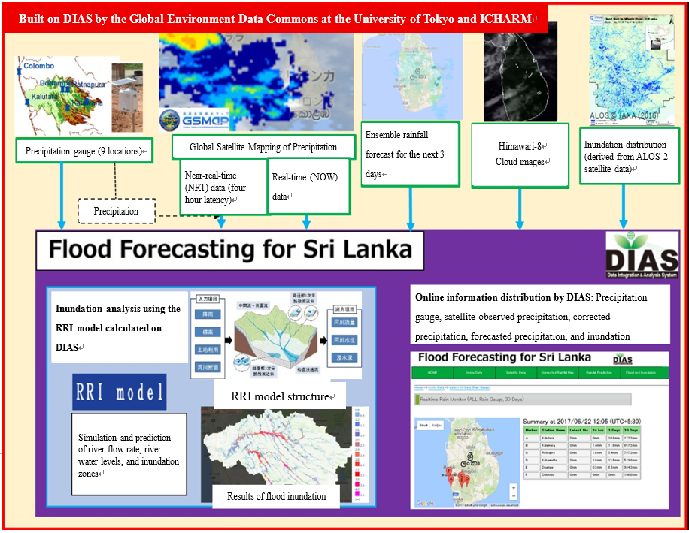
This figure shows the structure of the flood early warning system. The left half of the upper section illustrates how rainfall information is generated using precipitation gauges, satellite observations, and numerical predictions. The rainfall information is incorporated into the Rainfall-Runoff-Inundation (RRI) model developed by ICHARM, shown on the bottom left, to calculate the flood inundation distribution. These results are published on the website of the Data Integration and Analysis System (DIAS), which flood control authorities of the applicable countries can access, covering observed precipitation to river inundation distribution, as shown on the bottom right. We have also built similar systems along the Pampanga River in Luzon in the Philippines and along the Niger River in West Africa, and we also have plans for implementation in river basins in India, Kenya, South Sudan, and Ghana through projects with the World Bank and UNESCO.
(Contact : Hazard Research Team, ICHARM, PWRI)
Aiming to Build Preventive Infrastructure Maintenance Against Scour Occurred around Pier of Road Bridge
1.Introduction
CAESAR aims to build preventive infrastructure maintenance, which detects signs of deterioration before it can significantly impair the usability or critically compromise safety of bridges, and takes countermeasures as necessary.
As a part of them, we focus on scour, which is a phenomenon where flowing water causes the loss of the sand around a bridge pier or foundation. Some road bridges over rivers are damaged caused by scour annually, mainly during floods, and it is common for recovery to take several years (Photo 1). However, although damage occurs during flooding, post-flood investigations often find that signs of instability in the bridge foundation were already present even before the flooding. Therefore, in this article, we introduce some of the research we have conducted to detect signs of bridge instability caused by scour.
2.Detecting Signs of Bridge Instability Caused by Scour: Integrating Knowledge of Bridges and Rivers Engineering
Scour is a phenomenon where the soils around structures in flowing water is eroded. Because it is impossible to eliminate the phenomenon itself, we have so far taken measures such as deepening the foundation's embedment, as well as installing river-bed protection structures to prevent the bridge from immediately becoming unstable when the ground around the foundation is eroded by scour. However, examining recent cases of scour-damaged road bridges have revealed that the cause is not only local scour near the bridge pier but also the overall degradation of the river-bed resulting from the bipolarization* of the river channel. Against this backdrop, we have worked on solving problems from both the bridge perspective and the river perspective by collaborating with the River Dynamics Management Group, which is knowledgeable about the characteristics of river channels.
As one of these initiatives, we conducted movable-bed model experiments considering a local scour with bed degradation. As a result, we elucidated the process by which local scour (Photo 2) is facilitated by bed degradation (Photo 3).
※Bipolarization of the river channel: A situation where cross-sectional elevation difference widens over time between the water and land areas during base flow, leading to significant difference in flood volumes between them.
After reviewing the experimental results, we have tried to propose methods and timing for evaluating the condition of bridge piers against scour and estimating the depth of scour. Specifically, as to the method for evaluating the condition, we plan to study methods that can measure scour depth efficiently under a wider range of conditions, as well as more effective countermeasures against scour. We will continue to advance research to prevent damage caused by scour and contribute to building a resilient country.
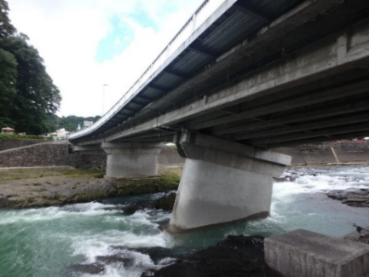
Case of damage caused by scour (tilted upstream) |
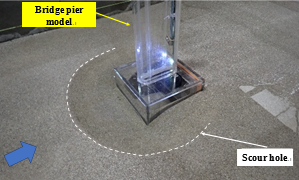
Local scour situation (at the end of the experiment) |
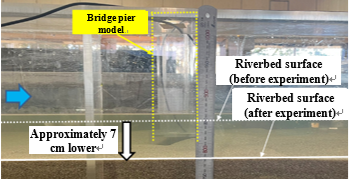
Riverbed lowering situation (at the end of the experiment) |
(Contact: Bridge and Structural Engineering Research Group)
Effective Extraction of Rockfall Source Areas from UAV Aerial Imagery
Japan is a mountainous country with limited flatlands, necessitating the construction of roads in areas with cliffs and slopes. Consequently, effective slope management is essential for maintaining safe and reliable road traffic. In Hokkaido, a major slope failure prompted a reevaluation of slope inspection practices. Since then, measures to prevent rock mass collapses and rockfalls have become a critical issue for ensuring public safety and road traffic reliability.
The Geological Hazards Research Team has been investigating a method to effectively detect rockfall occurrences using the background subtraction technique in aerial imagery captured by unmanned aerial vehicles (UAVs)(Figure 1).
This method involves overlaying two aerial photographs taken at different times and comparing the color differences between them. Unchanged areas appear black, while changed areas appear white, allowing for a clear visual distinction of areas of change, such as rockfall source areas(Figure 2).
Originally, the background subtraction technique was designed for fixed-position cameras, where the composition of the images remains constant. Our case studies, which have utilized aerial photos taken by UAV, were among the first reported applications of background subtraction.
The Geological Hazards Research Team investigated how UAV type and UAV positioning accuracy influence the effectiveness of background subtraction in identifying problematic locations. Confirming that when the same UAV (i.e., the same camera) is used and when the UAV positioning accuracy is high (position differences within a few centimeters), background subtraction is feasible, just as with fixed cameras.
Moreover, the application of orthorectification?which corrects for angular and positional distortions?was found to substantially improve the performance of extracting the rockfall areas using the background subtraction technique, rendering it robust across different UAV platforms. Consequently, the integration of UAV imagery with background subtraction allows for the precise detection of small-scale rockfall events (on the order of tens of centimeters) on remote slopes, which are typically difficult to identify through conventional visual inspection.
Small-scale slope changes such as rockfalls are difficult to detect using satellite or manned aircraft imagery due to insufficient spatial resolution. Ground-based inspections also have limitations in terms of the coverage and accessibility. Therefore, this UAV-based aerial imaging has emerged as an effective tool for accurately investigating areas that are otherwise inaccessible or visually obscured.
The Geological Hazards Research Team is actively working to implement this technique in the practical slope inspection while integrating the latest advancements in remote sensing tools.
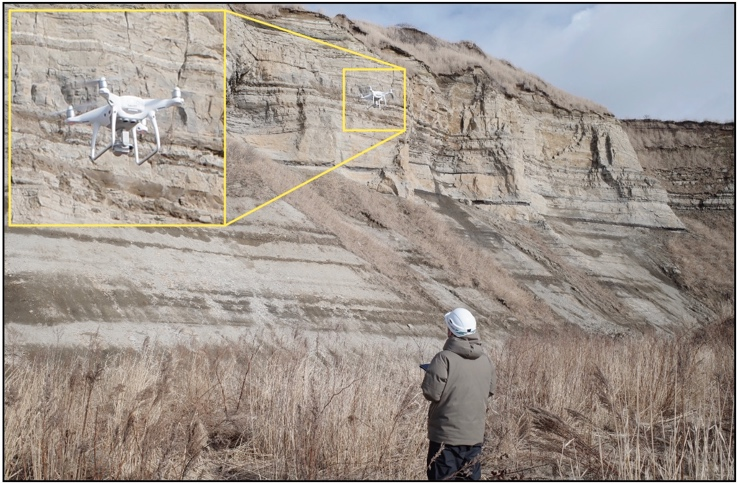
UAV-based survey on steep rock slope |
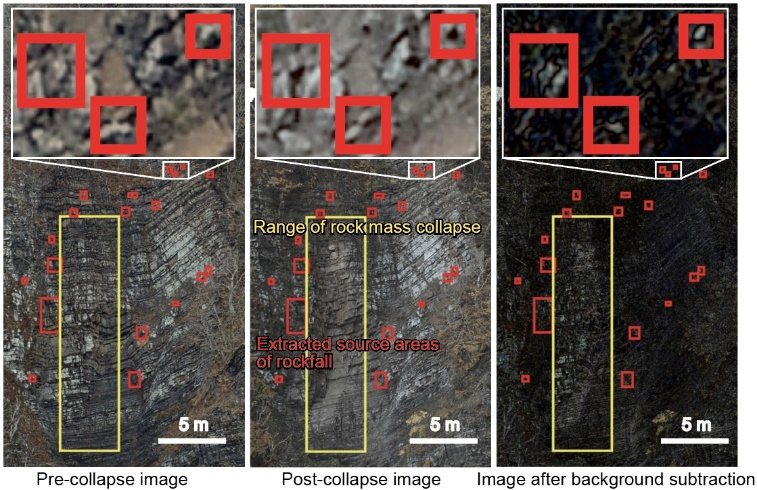
Background subtraction results showing slope surface changes |
(Contact : Geological Hazards Research Team,CERI)