



Impacts of Climate Change on the Intensity of Blizzards in Hokkaido
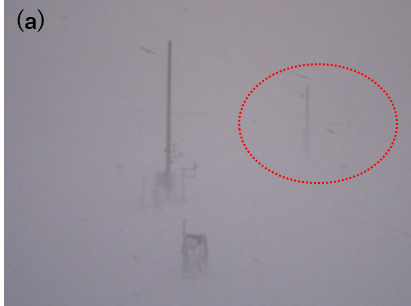
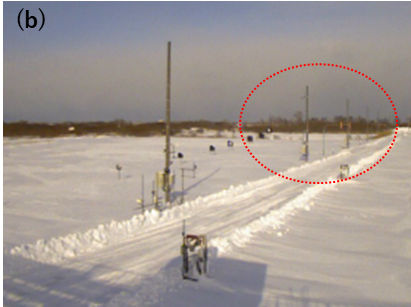
The impacts of climate change and global warming have already become evident, exemplified by decreases in winter snowfall. On the other hand, short-term snowfall, which serves as an indicator of blizzards and heavy snowfalls, is projected to remain at current levels or even to increase under future climate conditions, from the influence of climate change. Therefore, disasters caused by blizzards (Figure 1) and other severe snowstorms are expected to remain issues that must be addressed in road management in snowy and cold regions even under future climate scenarios. This study estimated the impact of climate change on blizzard intensity using a future climate simulation dataset.
We compared the current climate conditions over a 60-year period starting from 1951 with future climate projections based on a 2°C increase in global average air temperature. In general numerical weather simulations, an ensemble experiment approach is employed, where slightly different initial conditions are used for each run. Applying this ensemble method to future climate simulations enables low-probability extreme events to be estimated.
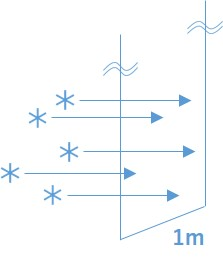
As an index of blizzard intensity, we utilized the hourly snow transport rate (kg/m/h), which represents the mass of snow particles passing through a unit width per unit time (Figure 2). In this study, we targeted four locations in Hokkaido with official AMeDAS weather stations: Haboro, Abashiri, Urakawa, and Iwamizawa. To improve the reliability of the simulation results, bias correction was applied at each site based on observed data.
We compared the exceedance probability of the hourly snow transport rate at each site across observation data, the current climate, and the 2°C warming climate (Figure 3). A smaller exceedance probability indicates a lower likelihood of a given hourly snow transport rate occurring. A comparison of the observation data to the data from the current climate simulation found a slight tendency toward overestimation for Haboro, whereas the results for other sites were generally well-reproduced. Based on the exceedance probabilities, it is estimated that blizzards with an hourly snow transport rate above 300 kg/m/h?corresponding to hourly mean visibility below 50 meters?occur about once per winter in Abashiri, and more than once per winter in Haboro and Urakawa. Under the 2°C warming climate climate, the frequency distribution is suggested to shift toward lower probabilities of severe blizzard events. Specifically, the hourly snow transport rate expected to occur once per winter is projected to decrease by up to 50% in Urakawa, while other locations show decreases of up to approximately 20%.
By applying this method to more locations, it is expected that recurrence probability distribution maps of blizzard events can be proposed. In the future, we aim to further develop this method and to continue to examine its application to meteorological mesh data.
|
|
|
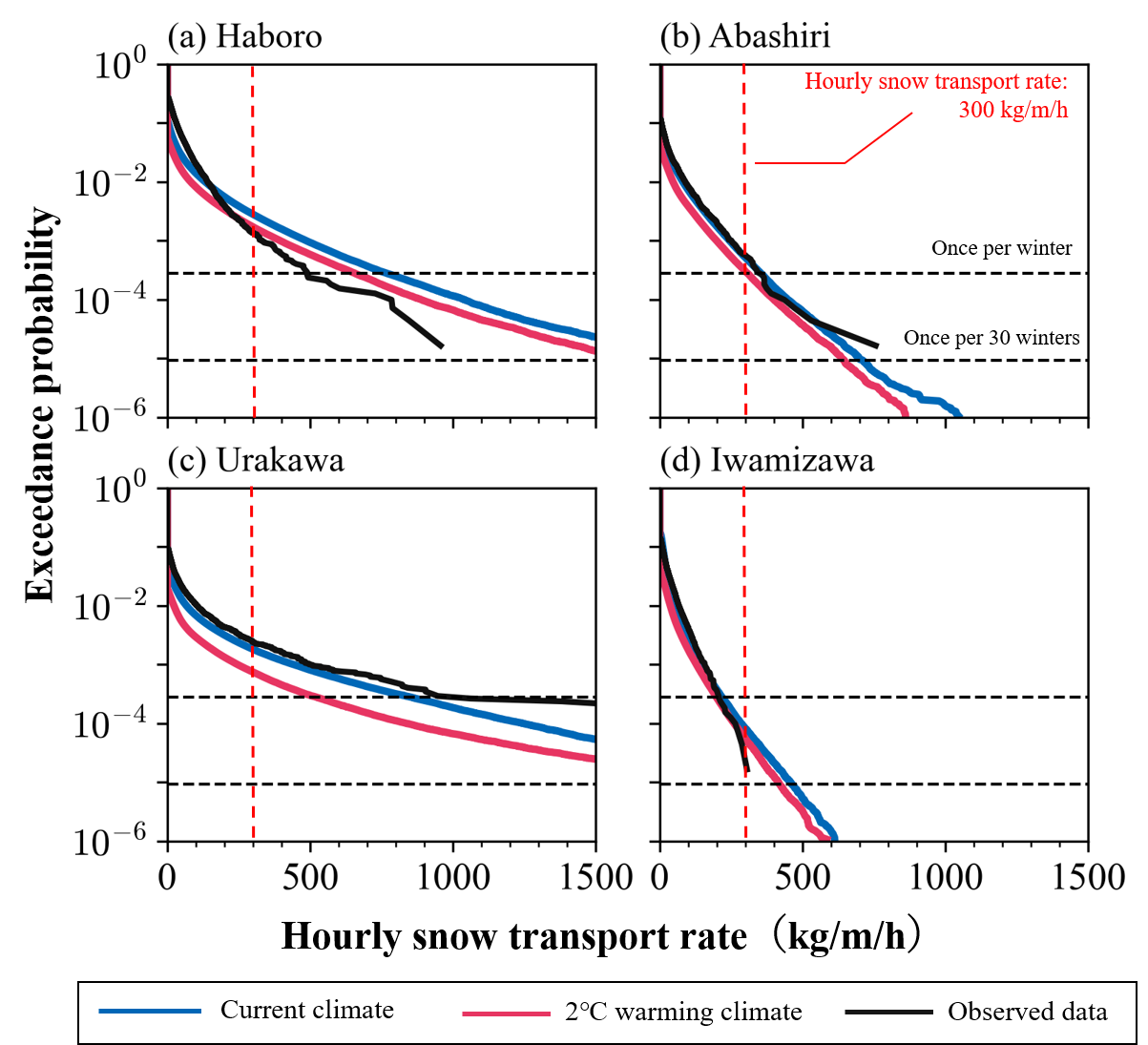
Blue, red, and black lines represent the current climate, 2°C warming climate, and observed data, respectively. The black dashed lines indicate the probability of occurrence. The top line represents an event occurring once per winter, while the bottom line represents an event occurring once every 30 winters. The vertical red dashed line indicates the hourly snow transport rate of 300 kg/m/h. |
(Contact : Snow and Ice Research Team, CERI)