



Development of Dam Sedimentation Countermeasure Technologies under SIP
Figure
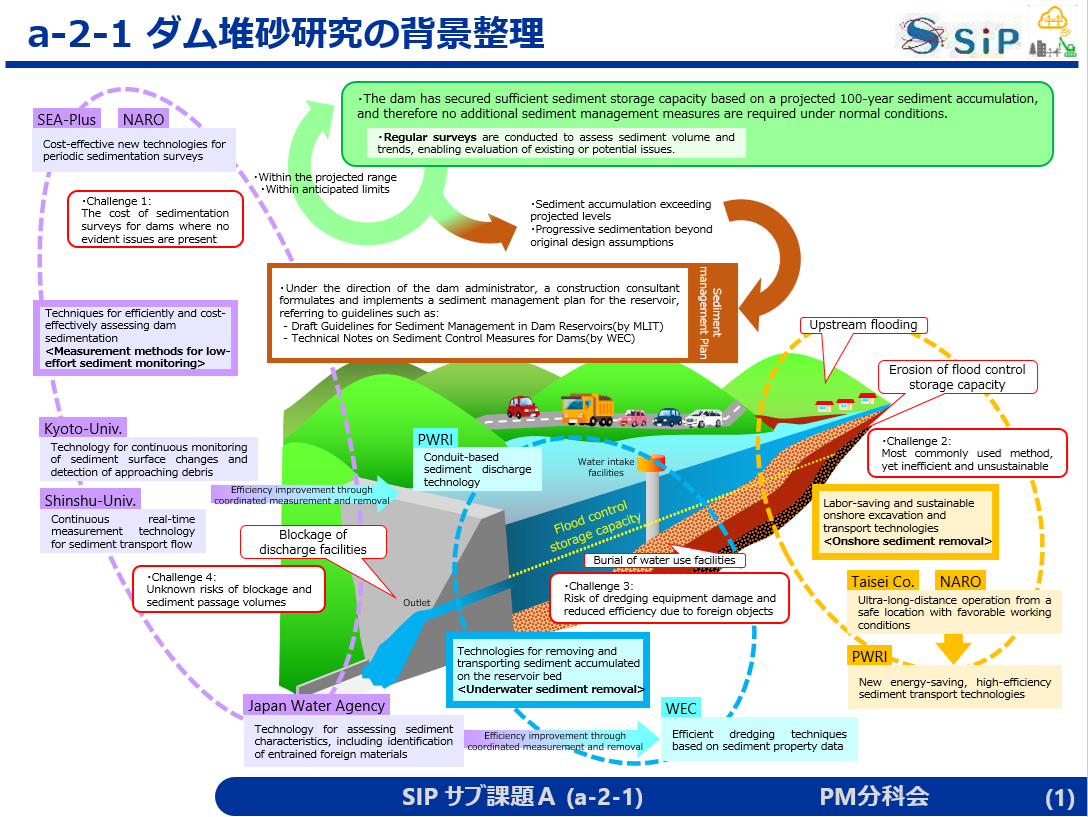
List of dam sedimentation
countermeasure technologies under
development in the SIP
Figure
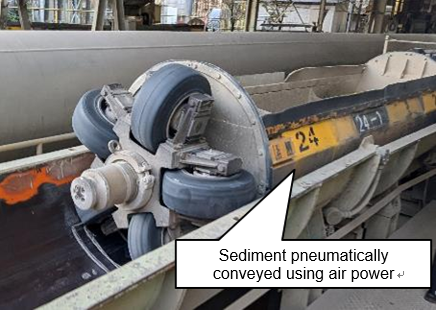
Example sediment transport technology
(pneumatic capsule transport)
Figure
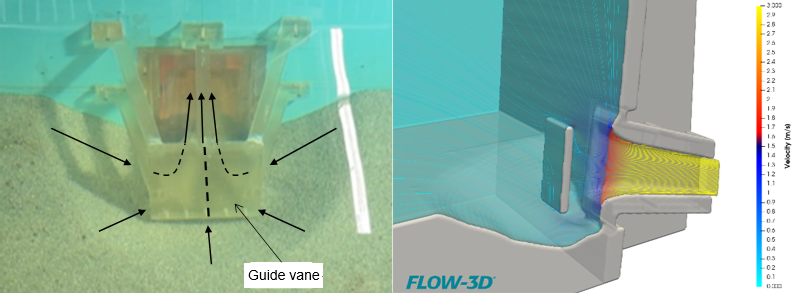
Study of auxiliary structures
to form stable sedimentation
geometry near conduit gates
Sedimentation is an unavoidable phenomenon at dams due to the continuous inflow of sediment from upstream. Consequently, dams are designed to provide sufficient capacity so that their functions can be maintained as sediment accumulates over a period of 100 years.
However, in recent years, increases in river discharge and the growing frequency of extreme events caused by climate change have accelerated sediment accumulation beyond design assumptions, bringing to light issues such as reduced storage capacity and impacts on discharge and intake facilities.
In response, PWRI, together with seven other organizations, is addressing dam sedimentation countermeasures under Japan’s Strategic Innovation Promotion Program (SIP).
(Reference: https://sip-icas-project.org/)
Under this program, development is being carried out with a focus on three fields related to sedimentation countermeasures: (1) sedimentation measurement; technologies to monitor dam sedimentation status and volumes (accumulated, bypassed) at reduced labor and cost, (2) on-land excavation; conducted in high-elevation areas to restore and secure flood control capacity, and (3) underwater dredging; conducted to maintain the functions of water use and discharge facilities.
Among these, PWRI is participating in the latter two fields, where action is taken when countermeasures are deemed necessary. With regard to (2), studies are being conducted on actual dams to evaluate the applicability of new methods for efficiently and continuously transporting large volumes of sediment, including cost factors, as alternatives to dump trucks and belt conveyors generally used in the past. With regard to (3),studies are being conducted on auxiliary structures intended to form and maintain stable sedimentation geometry near gates, where sediment approaches discharge facilities and increases the risk of blockage . In both areas, hydraulic model experiments and numerical simulations are being used.
PWRI will continue to work in collaboration with related organizations through the end of FY2027, when the program concludes, to advance efforts to realize more efficient dam sedimentation countermeasures.
(Contact : Hydraulics and Sediment Transport Engineering Team)
Verification of the Seismic Performance of Rubber Bearings through 100 Repeated Full-scale, Real-velocity Tests
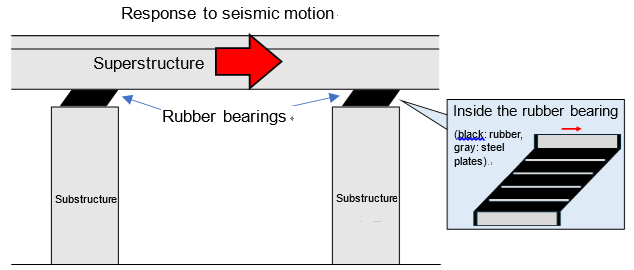
Fig.1
What is a rubber bearing?
1.Introduction
Recent large earthquakes have shown that not only the main shock, but also multiple strong motions comparable to the main shock, can occur repeatedly.
For this reason, it is essential that road bridges maintain their functionality even in the face of repeated seismic motion. In particular, bearings are critical components because they connect the superstructure and substructure of a bridge; failure of bearings during an earthquake can lead to bridge collapse (Fig.1)).
Consequently, we used state-of-the-art equipment to test full-scale models of laminated rubber bearings (bearings in which rubber is reinforced with steel plates), which have entered into widespread use over the past 30 years, by applying forces and deformations equivalent to actual earthquake motion to evaluate their seismic resistance.
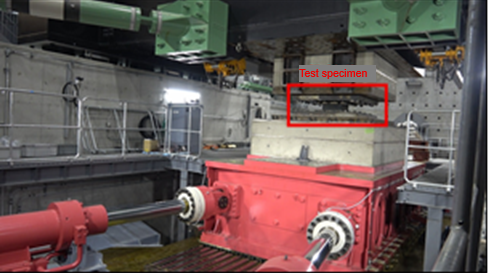
Photograph 1
A rubber bearing installed in the
E-Isolation testing machine
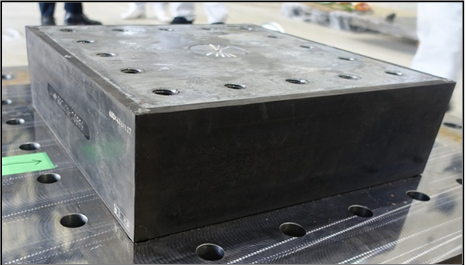
Photograph 2
Condition of the rubber bearing
after 100 loading cycles
2.Expected outcomes
This experiment makes it possible to verify whether full-scale rubber bearings designed to current standards can withstand repeated seismic motion. Because the number of times seismic motion may occur is unpredictable, the test applied shaking with an amplitude equivalent to a main shock 100 times to provide sufficient margin.
The results are expected to yield data useful for improving seismic design practices for bridges and to provide a basis for determining whether bridges can continue to be used safely after earthquakes. The findings will also contribute to the development of guidelines for enhancing the safety of future bridge designs. Notably, we consider this full-scale experiment assuming consecutive strong shaking to be the first of its kind in the world.
3Experimental overview and results
The experiment utilized a testing machine known as E-Isolation (Photograph 1). A full-scale rubber bearing with dimensions representative of those used in small-scale bridges (420 mm × 420 mm × 127 mm) was subjected to shaking corresponding to the maximum deformation assumed during an earthquake, applied at a period of 2 seconds across 100 cycles.
The bearing was found to maintain consistent performance in terms of stiffness and damping, and no damage such as cracking or bulging was observed on the surface after the 100 cycles of shaking (Photograph 2). In other words, the tests demonstrated that rubber bearings are able to maintain their functionality in the face of repeated strong seismic motion.
(Contact: Bridge and Structural Engineering Research Group)
Research and Development Aimed at Establishing a Simple Method for Detecting Abnormalities in Road Bridge Piers Following Large-Scale Earthquakes
Following a major earthquake, it is desirable to assess the safety and serviceability of road bridges as early as possible.
However, bridge pier bases?where damage is highly likely?are often located in soil sections or underwater, making rapid visual inspection difficult. For such assessments, therefore, we focused on Bayesian anomaly detection methods. These methods detect state changes using features derived from parameters such as dominant frequencies, vibration modes, and damping during structural vibration. This probabilistic approach has already demonstrated results in damage detection for signposts1) and PC girders2).
In a basic feasibility study conducted in fiscal 2024 on applying this approach to RC bridge piers, the progression of base damage was detected through changes in these features, as shown in Figure 2.
Aiming to establish a method for detecting abnormal conditions in RC bridge piers by the end of fiscal 2027, we are advancing studies using models like that shown in Photo 1. Furthermore, with the cooperation of the Hokkaido Development Bureau of the Ministry of Land, Infrastructure, Transport and Tourism, we are investigating vibration excitation methods and conducting vibration measurements on existing structures (Photo 2).
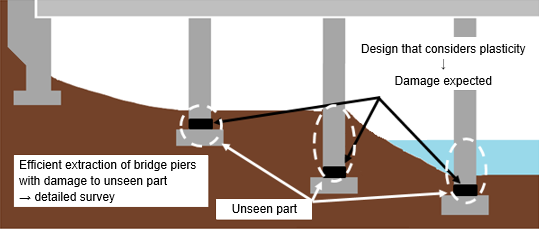
Figure 1
Locations of bridge pier bases with high potential for damage
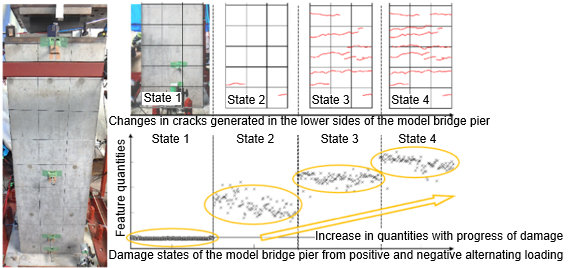
Figure 2
Changes in feature quantities accompanying the progression of base damage in a model bridge pier
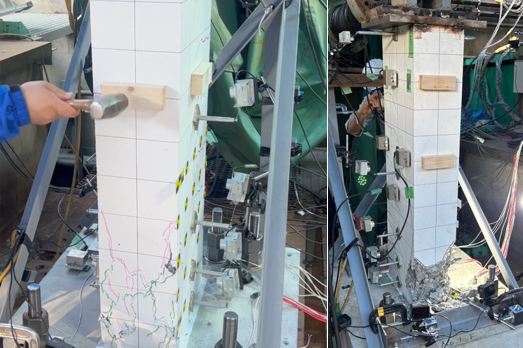
Photo 1
Test study for extracting feature quantities corresponding to damage progression
(Left: Measurement of vibration due to impact;
Right: Model bridge pier with significant damage to the base)
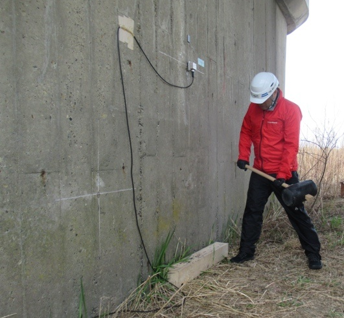
Photo 2
Vibration measurement on a bridge pier
1) Ryota Ichikawa, Yoshinao Goi, Daigo Kawabe, Kazuo Takase, Yukio Adachi, Kunitomo Sugiura: Fatigue Crack Detection using Vibration Data in a Full-Scale Sign Pole Laboratory Experiment, Journal of Structural Engineering, Vol. 69A, pp. 467-474, 2023.
2) Daigo Kawabe, Yoshinao Goi, Chul-Woo Kim: Application of Bayesian Anomaly Detection Methods to PC Bridges in Service, Proceedings of the Japan Concrete Institute, Vol. 43, No. 2, pp. 583-588, 2021.
(Contact : Structures Research Team,CERI)