



Supporting the Future of Sea Cucumber Fisheries: Introducing a Compact, Lightweight, Low-Cost Rearing Reef
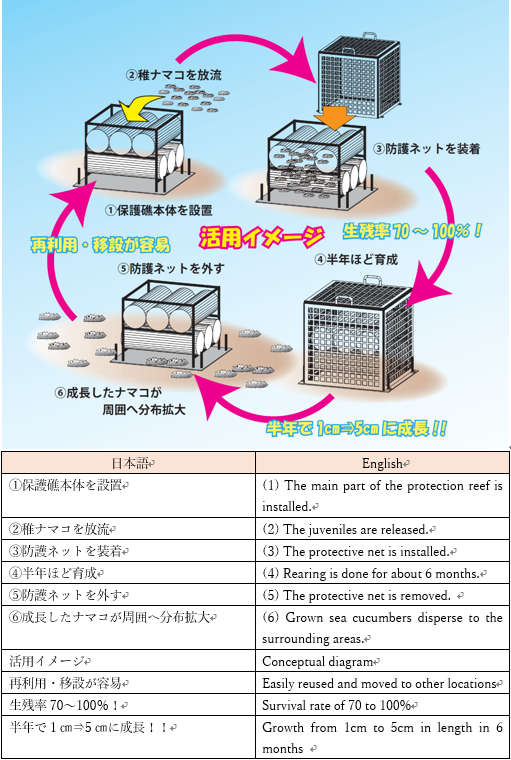
Figure 1
Conceptual diagram of the Sea
Cucumber Cradle in use
1.Current Status and Challenges of Sea Cucumber Resources
Sea cucumbers are harvested throughout Japan, with the majority exported to Hong Kong, China, and Taiwan. In 2023, exports totaled 344 tons, valued at \16.9 billion (Ministry of Agriculture, Forestry and Fisheries, “Agricultural, Forestry and Fishery Products Import/Export Information”), making sea cucumbers one of Japan's leading export fishery products.
In Hokkaido, which has the highest catch volume in Japan, sea cucumber exports rank second only to scallop exports in value, reaching 6.8 billion yen annually (Ministry of Finance, “Trade Statistics for 2023”; Hakodate Customs, “Hokkaido Trade Overview for 2023”), making them a crucial pillar supporting the regional economy.
However, in recent years, sea cucumber resources have continued to decline, with Hokkaido's catch also falling steadily since peaking in 2007. To restore stocks, juvenile-release aquaculture programs (in which sea cucumbers artificially hatched on land are raised to a certain size before being released into the sea) have been implemented in various locations. However, these efforts have not yielded the expected results.
This is because there has been limited knowledge about the ecology and distribution of sea cucumbers (particularly Apostichopus japonicus) in their natural environment, making it unclear what optimal conditions for release would maximize survival rates.
Therefore, the Fisheries Engineering Research Team collaborated with Ocean Construction Co., Ltd. to conduct field surveys and demonstration tests at fishing ports in Hokkaido over a six-year period starting in 2016. Based on the results, we developed and commercialized the Sea Cucumber Cradle, an intermediate-rearing reef that utilizes calm fishing port waters. This reef maintains high survival rates for released juveniles, while achieving rapid growth in a short period.
Furthermore, the research revealed for the first time globally that the kelp crab (Pugettia ferox) and the hermit crab (Paguristes ortmanni) are particularly dangerous predatory organisms for juvenile sea cucumbers.
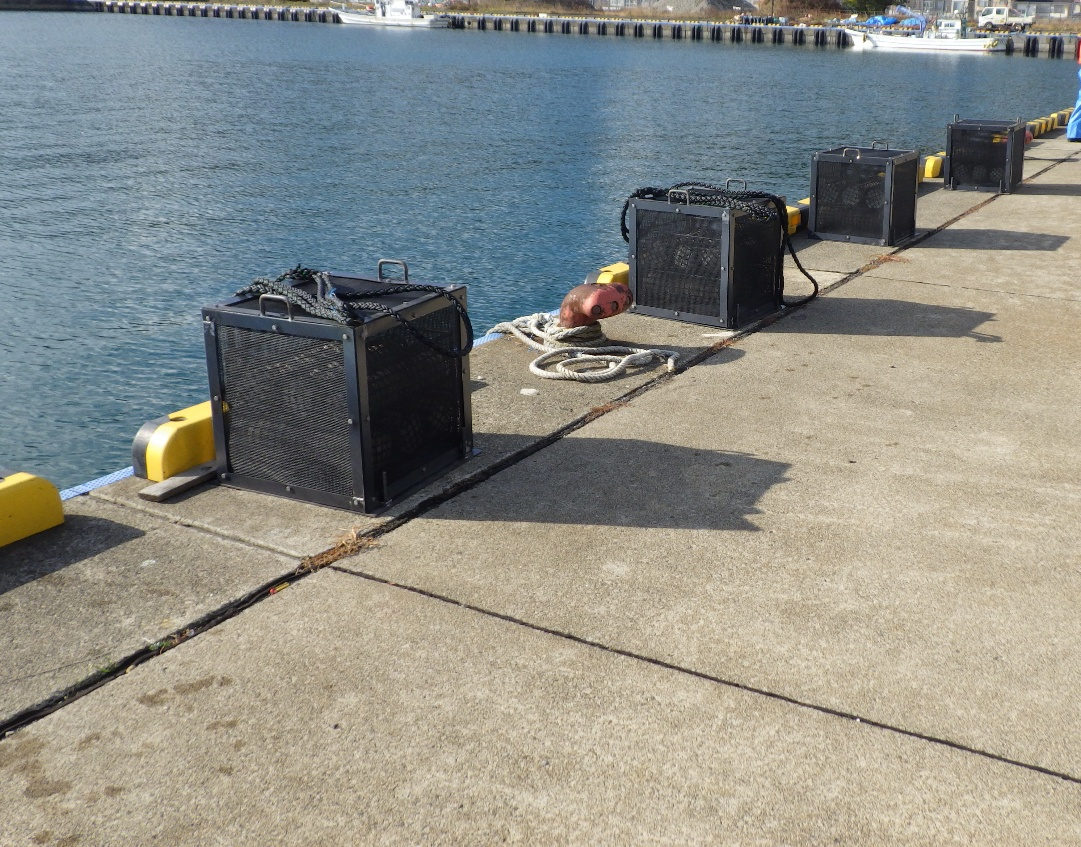
Photo 1
Sea Cucumber Cradles before installation
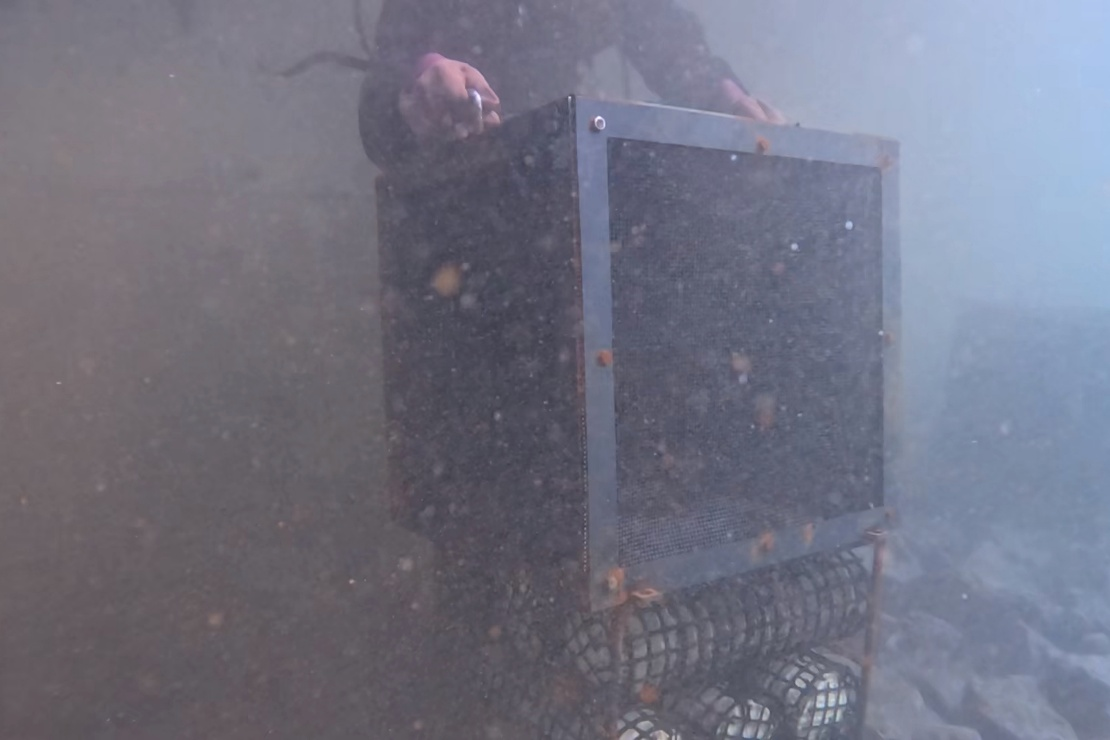
Photo 2
Installation of the protective net
2.Features of the Sea Cucumber Cradle
The developed Sea Cucumber Cradle has the following features:
(1)Significant improvement in the survival rate
When 1- to 2-cm-long sea cucumber juveniles are released onto substrates placed in fishing ports without protective measures, the survival rate at six months to a year can sometimes fall below 10%. However, by using the outer part net of the Cradle to protect the juveniles from predators (especially hermit crabs and other crabs), the survival rate can be increased to 70% to 100%.
(2)Creating an environment conducive to growth
Inside, scallop shells serve as substrates for sea cucumbers to attach to and inhabit. This substrate readily accumulates microorganisms and organic matter that serve as food, aiding growth.
(3)Installable in various locations
The structure is designed to allow installation even in areas prone to sediment influx or on soft seabeds.
(4)Predator-proof design resistant to clogging
Adjusting the mesh size of the protective netting prevents predator intrusion and sea cucumber escape while minimizing clogging from suspended silt or attached organisms.
(5)Compact, lightweight, and easy to handle
This small and lightweight rearing reef allows fishermen to install it themselves without large cranes or other heavy machinery.
3.Benefits of implementation and prospects
The Sea Cucumber Cradle significantly improves survival rates and growth after juvenile release, leading to expected increases in catch volume.
The Sea Cucumber Cradle is being introduced in various locations, primarily within Hokkaido, including Fukushima Town.
https://www.ceri.go.jp/data/files/20251125.pdf
(Contact : Fisheries Engineering Research Team, CERI)