



Technology for Utilizing Soft Soil as an Embankment Material
-- Crushed Solidified Soil--
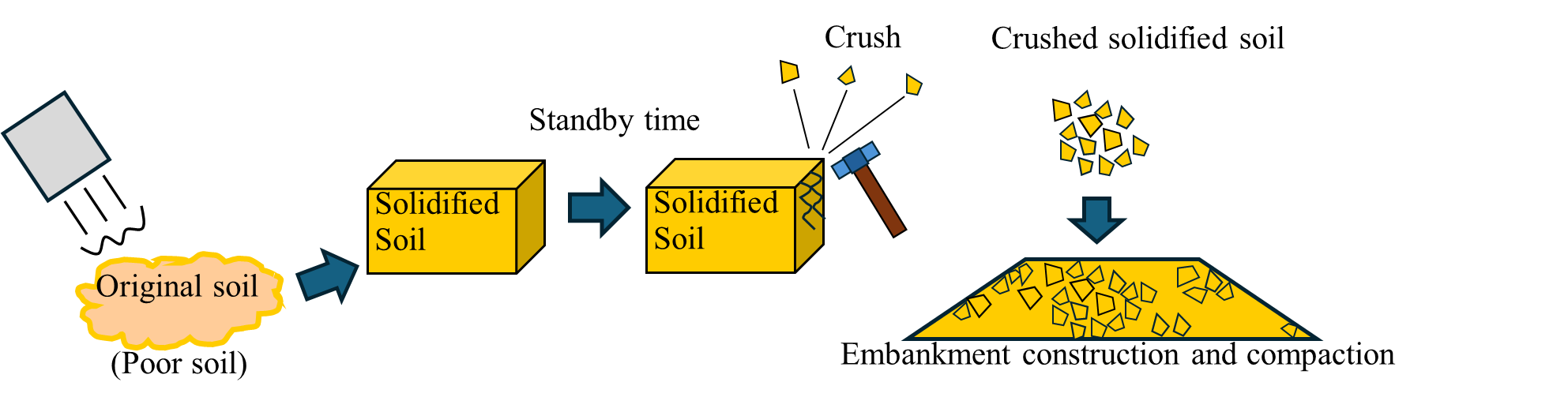
Figure 1
:Process for the production
and construction of crushed
solidified soil
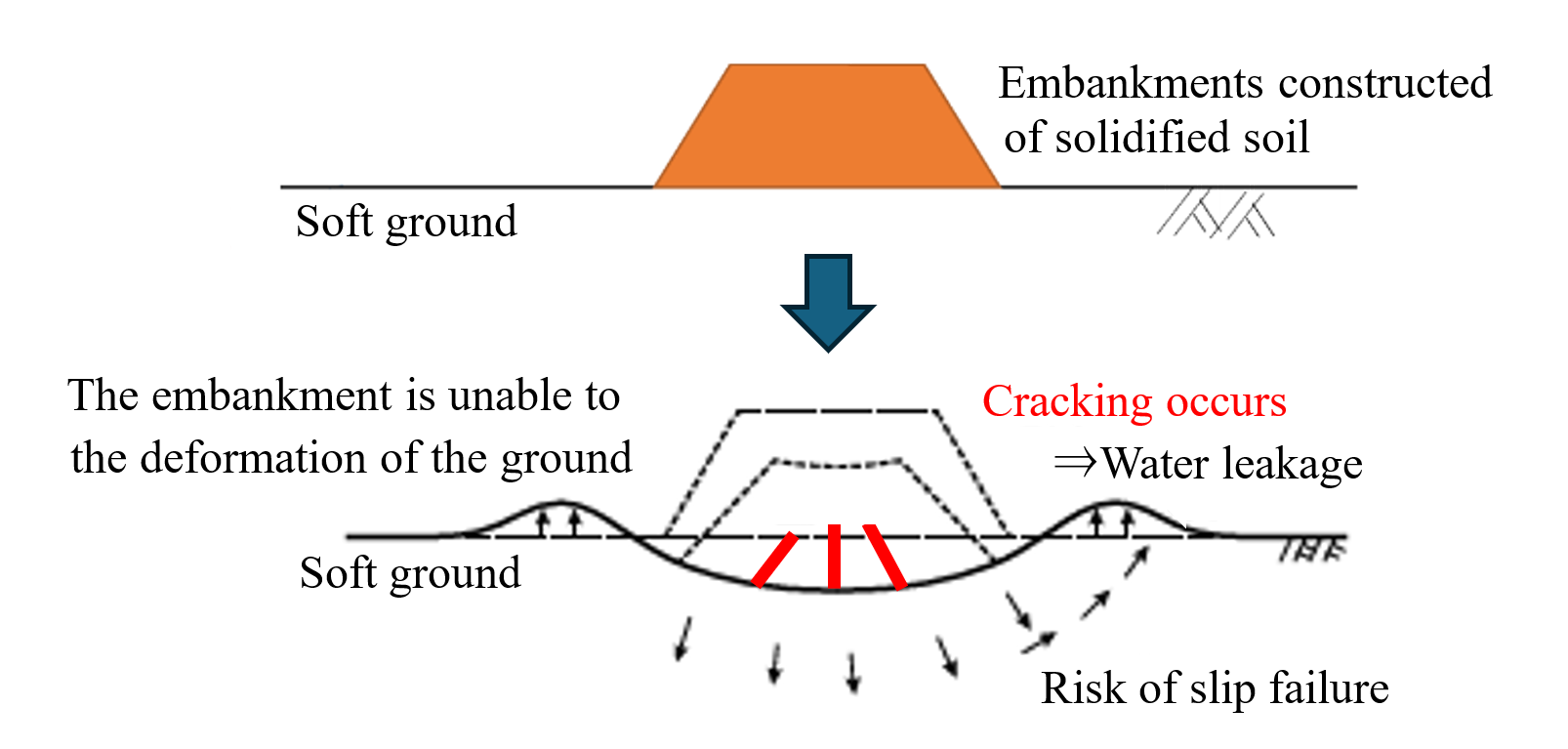
Figure 2
:Deformation of soft ground
due to the embankment
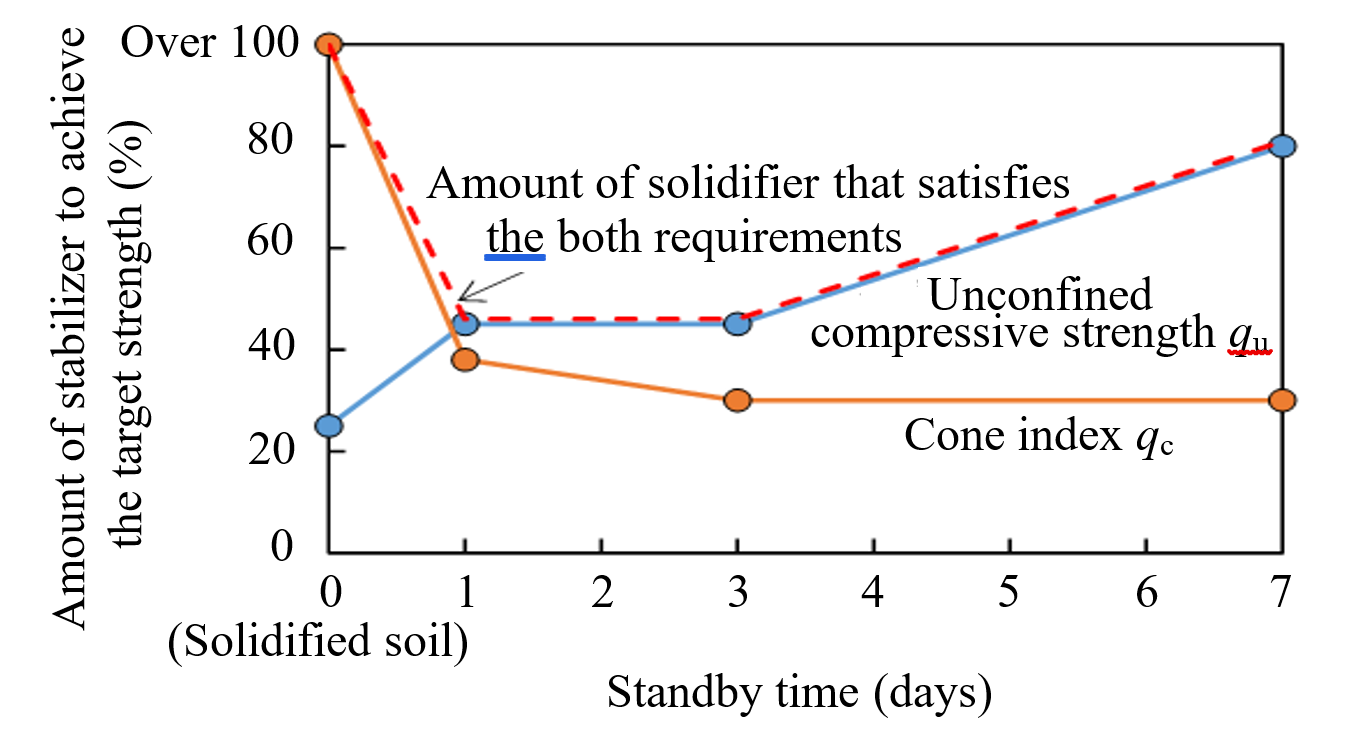
Figure 3
:Content of solidifying agent
required to achieve target
strength vs. days of standby
In Japan, river channel excavation (the deepening and widening rivers of by cutting out the riverbed and riverbanks) is being promoted as a flood control measure to safely channel floodwaters. This process generates large quantities of sediment. From the perspective of the effective utilization of resources, this sediment is often used as a material for embankments. If the generated river sediment is suitable for such use, it can be used as-is without any treatment. However, if it consists of water-saturated weak clay or other poor-quality soil, it cannot be used directly for construction. Therefore, the use of crushed solidified soil was developed as a technology for improving poor-quality soil into a material suitable for embankment construction.
Crushed solidified soil, as shown in Figure 1, is produced by mixing poor-quality soil with a stabilizer (primarily cement), allowing the soft soil and stabilizer to react, and then crushing the solidified soil into a state resembling that of ordinary soil. This solidification and crushing process enables the use of originally soft soil as an embankment material. Standard construction processes, such as machine spreading and compaction, are applicable to the processed soil.
While soil solidification has long been used as a technique for strengthening soft soil that is to be used as an embankment material, it has faced an issue: Reducing the moisture content (the pore water weight as a share of the soil weight) to a workable level required large amounts of stabilizer, potentially making it uneconomical. Furthermore, over time, the soil can excessively harden because of the remaining reaction between the soil and the stabilizer. Embankments constructed with solidified soil on weak foundations might fail to accommodate deformation from consolidation settlement, leading to cracks in the embankment and potentially compromising its function as a levee (Figure 2) . Crushed solidified soil offers one solution to this issue.
The Geotechnical Research Team conducted tests to determine whether peat distributed in Hokkaido (poor soil with a moisture content of approx. 600%) could be used as crushed solidified soil and to compare the required quantities of stabilizer between solidified soil and crushed solidified soil. For this study, the strength targets for improving peaty soil to ensure embankment stability were set as follows: a cone index (the force required to push a pointed rod into the soil) of 500 kN/m² to allow standard bulldozers to operate on the soil, and a uniaxial compressive strength (the force required to crush a cylindrical soil sample from above) of 150 kN/m² at 7 days of curing. The results are shown in Figure 3. For solidified soil, the amount of stabilizer required to achieve the target cone index was at least 100%, and the amount required to achieve the target uniaxial compressive strength was at least 22%. Therefore, the amount of stabilizer needed to satisfy both requirements is at least 100%. For crushed solidified soil prepared by crushing after, for example, 1 day of standby, the stabilizer required to achieve the target cone index was at least 38%, and the stabilizer required to achieve the target uniaxial compressive strength was at least 45%. Therefore, the amount of stabilizer needed to satisfy both requirements is at least 45%. Using crushed solidified soil allows the use of less than half the stabilizer than that for solidified soil.
As a rational technology for embankment materials, crushed solidified soil is expected to be useful in various situations. The following references are useful and are recommended for review.
(References)
・SATO Atsuko, YAMAKI Masahiko, HIROSE Junji, YANAZAKI Tomohiro:
The Strength Characteristics of a Trial Embankment Constructed of Crushed Solidified Soil,
Proceedings of the 16th National Symposium for Ground Improvement, pp. 544-549, 2024.
https://thesis.ceri.go.jp/db/files/1615447123672993b50eeb8.pdf
・SATO Atsuko: On Crushed Solidified Soil,
Monthly Report of the Civil Engineering Research Institute for Cold Region, No. 849, pp. 47-51, 2023.
https://thesis.ceri.go.jp/db/files/715750806651e60a19ecda.pdf
(For more information: Civil Engineering Research Institute for Cold Region Road Geotechnical Research Team)