Information Networking
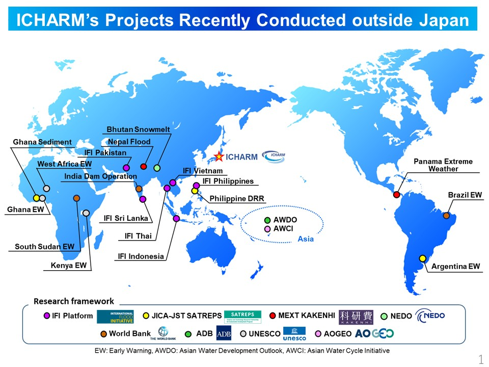
In its long‑term program (approximately 10 years), ICHARM defines its information networking activity as follows:
|
In line with this policy, ICHARM focuses on the following three areas of activity:
|
Based on this long‑term program, ICHARM has actively promoted information networking activities over the past decade through its role as the IFI secretariat. In particular, we have supported various countries in establishing and operating “Platforms on Water Resilience and Disasters.”
Within the Typhoon Committee, a senior researcher of ICHARM has served as the chair of the Working Group on Hydrology and contributed to the committee’s activities by leading discussions in collaboration with MLIT of Japan. By participating in various working‑group meetings and working closely with MLIT and other partners, ICHARM has helped advance the mainstreaming of disaster risk reduction worldwide, drawing on Japan’s extensive experience and expertise in disaster management.
Furthermore, as a UNESCO Category 2 Centre, ICHARM has actively contributed to the international hydrological community through a range of activities aligned with the UNESCO IHP‑IX: 2022–2029. In addition, by working in partnership with international organizations such as WMO and UNDRR, ICHARM has continued to play an active role in advancing global efforts in the field of hydrology.
Through these activities, ICHARM has worked with countries around the world to put into practice and advance initiatives based on the concept of the Water Cycle Integrator, which we advocate. At the same time, by further strengthening its networks with flood experts and government officials both in Japan and abroad, ICHARM has reinforced effective information networking, one of its three core pillars.
1) International Flood Initiative (IFI)
・Table 1:IFI History after 2016
・IFI Website: https://www.pwri.go.jp/icharm/ifi/index.html
2) Typhoon Committee
3) Mainstreaming Disaster Risk Reduction in Collaboration with International Organizations
a)Contributions to the United Nations in water‑related disaster risk reduction
(1) UN Special Thematic Session on Water and Disaster
(2) 2023 UN Water Conference
b)Contributions to UNESCO and international engagement in the water sector
through UNESCO
(1) Contribution to UNESCO IHP‑IX
(2) Participation in UNESCO‑hosted international conferences and symposia
c)Collaboration with other organizations
(1) World Meteorological Organization
(2) Collaboration with UNDRR
4)Mainstreaming Disaster Risk Reduction through International Conferences
c)Asia Pacific Water Summit (APWS)
5)ICHARM Visitor
From fiscal year 2016 to fiscal year 2025, approximately 840 people from 58 countries, including Japan, visited ICHARM to exchange opinions and so on.
Table 2: Number of participants by year and by country