
ICHARM has been cooperating in a research project entitled “Development of a Hybrid Water-Related Disaster Risk Assessment Technology for Sustainable Local Economic Development Policy under Climate Change (HyDEPP-SATREPS).” This project is led by Principal Investigator OHARA Miho, a professor at the University of Tokyo, under the Science and Technology Research Partnership for Sustainable Development (SATREPS), a joint initiative of the Japan International Cooperation Agency (JICA) and the Japan Science and Technology Agency (JST). As part of this project, 12 researchers from the University of the Philippines Los Baños and a practitioner from the Laguna Lake Development Authority, who are involved in the project, stayed in Japan from February 24 to March 3, 2026, to participate in a training program. The main purposes of this training were to participate in field visits to observe Japan’s good practices in hydrological and agricultural policies and to attend the project’s final symposium.
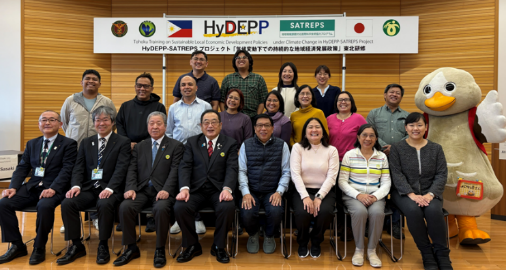
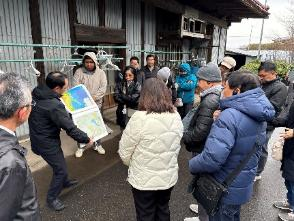
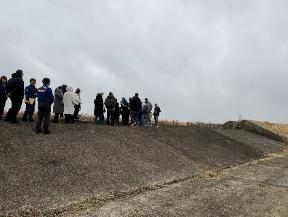
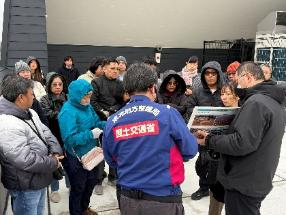
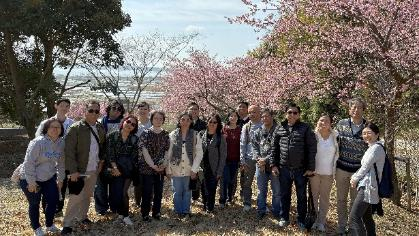
From February 25 to 26, 13 Philippine participants visited Osaki City in Miyagi Prefecture, accompanied by Japanese researchers, including Professor Ohara and Research Specialist NAGUMO Naoko. Osaki City is known for its vast rice paddy fields, the “Osaki Kodo,” where Japan’s basin management policy, “River Basin Disaster Resilience and Sustainability by All," has been proactively promoted through traditional water management systems, ecosystem conservation, and the use of paddy fields for temporary floodwater storage. This field visit was made possible with the cooperation of the Osaki City Office, the Kitakami River Lower Reach River Office, and the Tsuruta River Coastal Land Improvement District. The participants first paid a courtesy visit to Osaki City Mayor ITO Yasushi (Photo 1), and then visited traditional houses surrounded by homestead woodlands called “Igune,” as well as Kejyonuma, a wetland designated under the Ramsar Convention. On the following day, the participants visited several flood control structures, including the secondary levees in the Kashimadai area, the Genroku Senketsu drainage tunnel, and the Maekawa floodway (Photo 2). On February 28, the participants moved to Ibaraki Prefecture and visited the Ibaraki Kasumigaura Environmental Science Center, where they learned about the ecosystem and history of Lake Kasumigaura, as well as efforts related to water quality management, research, and environmental conservation (Photo 3).
At the closing ceremony of the training program held on March 2, the participants commented that they were impressed by several aspects observed in Osaki City, including the fact that flood management is becoming the foundation of agriculture, the integration of traditional knowledge and modern technology in flood control and water use, and the cooperation among different organizations toward shared goals. Some participants also noted that they would like to introduce these examples in their university classes so that their students can learn from Japan’s experiences. In addition, they remarked that Lake Kasumigaura is similar to Laguna Lake in the Philippines, one of the project’s target areas, in several respects, such as its shallow depth and its history of water pollution and flooding. They also mentioned that the efforts related to water quality monitoring, research activities, environmental conservation, and information dissemination through the museum were highly informative and useful.
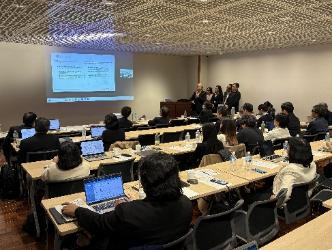
On February 27, the “Co-design of Sustainable Local Economic Development Policies under Climate Change: HyDEPP-SATREPS Philippines Final Symposium” was held at the University of Tokyo. During the event, the participants presented the background and process of developing the policy recommendations produced as one of the final outputs of the project. From ICHARM, Research Specialist Ralph Acierto introduced research results on climate change projections, and Senior Researcher Mohamed Rasmy presented studies on flood and drought assessments under climate change (Photo 4).
This training program, the final one held in Japan under this project, was productive and insightful, as it provided an opportunity to introduce good practices in Japan on flood control, water use and agriculture. Until the project concludes in May 2026, ICHARM will continue working with the Philippine counterparts to compile and disseminate the project outcomes.
 |
||
 |
 |
 |
 |
 |
|