Visit by senior officials from Japan and abroad for a laboratory tour at PWRI and research presentations at ICHARM
On July 27, 2026, ICHARM welcomed five senior officials from Japan and abroad and provided research presentations. They visited ICHARM as part of their visit to PWRI, which was arranged at the request of the International Affairs Office of the River Planning Division, the Water and Disaster Management Bureau, the Ministry of Land, Infrastructure, Transport and Tourism of Japan. They also toured one of PWRI’s laboratories. The participating officials were as follows:
- H.E. Hani Sewilam, Minister of Water Resources and Irrigation, Arab Republic of Egypt
- Ms. Yoko Kamikawa, Special Envoy of the Prime Minister for the 2026 UN Water Conference; Member of the House of Representatives; Former Minister for Foreign Affairs
- H.E. Abdulla Ahmed Balalaa, Assistant Minister of Foreign Affairs for Energy and Sustainability, Ministry of Foreign Affairs, United Arab Emirates
- Dr. Pema Gyamtsho, Director General, International Centre for Integrated Mountain Development (ICIMOD)
- H.E. Ragui ElEtreby, Ambassador of the Arab Republic of Egypt to Japan
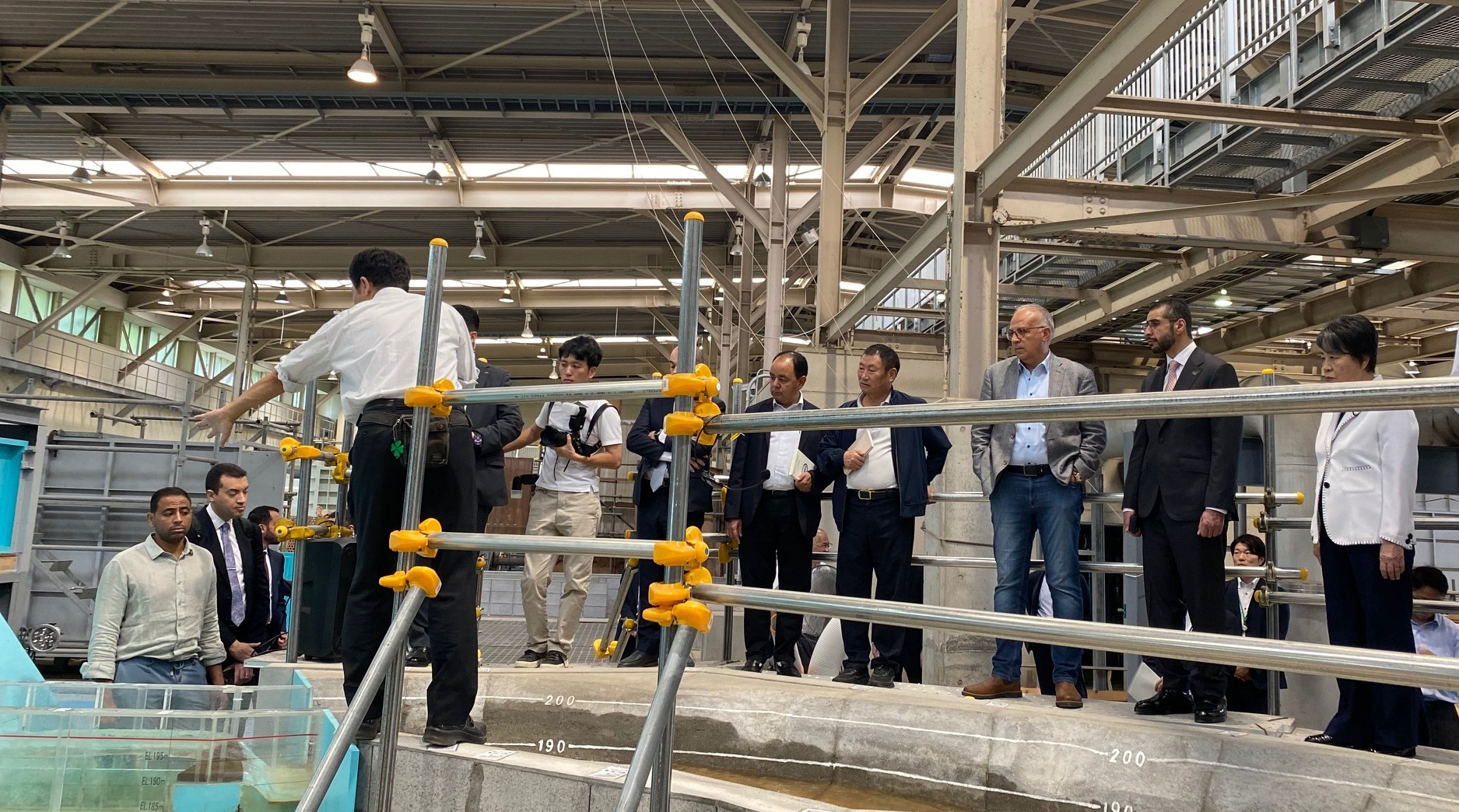 |
| Team Leader Mizukusa explaining an experiment |
The visit began with a tour of the Dam Hydraulic Laboratory, where Team Leader MIZUKUSA Koichi of the River Dynamics Management Group explained Japan’s dam development status and the Daido River Dam model experiment.
The visitors then moved to the ICHARM auditorium, where they received research presentations, moderated by Chief Researcher KURIBAYASHI Daisuke, with PWRI President FUJITA Koichi also in attendance. Following an overview of ICHARM presented by Deputy Director ITAGAKI Osamu, a researcher and two graduate students delivered presentations on their work.
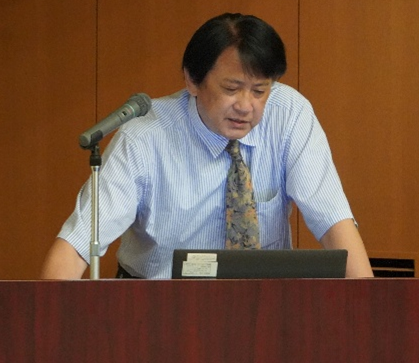
Research Specialist Tsutsui |
Research Specialist TSUTSUI Hiroyuki delivered a presentation titled “Agricultural Drought Assessment,” covering the following points:
- Introduction of an agricultural drought assessment method using satellite remote sensing and data assimilation technologies. He explained how the Coupled Land and Vegetation Data Assimilation System (CLVDAS) estimates root‑zone soil moisture and vegetation water content (“green water”) and presented analysis results on agricultural impacts in Africa, particularly in South Sudan.
- Development of a model linking vegetation water content to crop yields. Using this model, he estimated maize and sorghum yields and demonstrated how differences in crop damage caused by floods and droughts can be identified.
- Emphasis on the importance of strategic planning for water‑infrastructure options to sustain and improve agricultural production in response to climate‑induced changes in the water cycle.
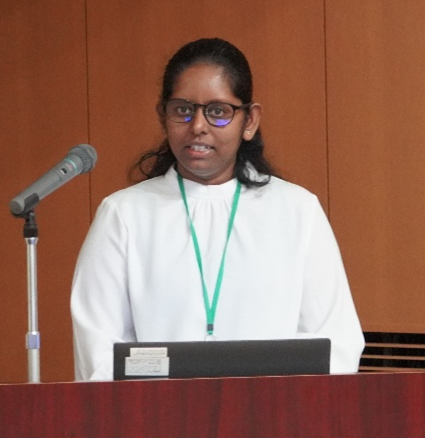
Ranapura Dewage Thilini Kausyalya |
Ranapura Dewage Thilini Kausyalya, a doctoral student and an officer of the Irrigation Department of Sri Lanka, delivered a presentation titled “Water and Poverty,” covering the following points:
- Explanation of how water insecurity is a major driver of poverty, illustrated through cases from Sri Lanka.
- Description of the severe impacts on rural livelihoods and agriculture caused by floods and droughts, which occur despite abundant rainfall due to strong spatial and seasonal variability.
- Discussion of how water‑quality degradation and increasing disaster risks driven by climate change further deepen poverty among vulnerable groups.
- Introduction of water‑resources management initiatives such as the Mahaweli Development Program, which have contributed to improvements in agriculture, livelihoods, and energy supply in Sri Lanka.
- Conclusion that climate change adaptation and integrated water‑resources management are essential for sustainable development and poverty reduction.
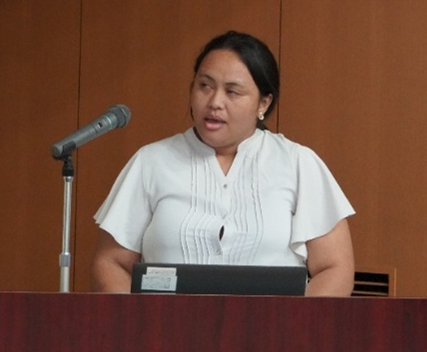
Rambolamanana Faranirina Sarindra |
Rambolamanana Faranirina Sarindra, a master’s student and an officer of the Ministry of Public Works of Madagascar, delivered a presentation titled “The Effect of Solid Waste on Urban Flood and Sanitation in Madagascar,” covering the following points:
- Analysis of the impacts of solid waste on urban flooding and sanitation issues in Madagascar.
- Explanation of how clogged drainage channels in the capital, Antananarivo, exacerbate flooding, leading to contamination of drinking water, malfunctioning toilets, and the spread of infectious diseases.
- Presentation of a quantitative assessment integrating the Rainfall-Runoff-Inundation Model with the drainage network, evaluating reduced drainage capacity and resulting inundation caused by waste accumulation.
- Identification of bridge areas as major bottlenecks, and recommendation that improving drainage infrastructure, strengthening waste collection, enhancing inter‑agency coordination, and prioritizing investment in the water and sanitation sectors are essential for reducing flood risk and improving public health.
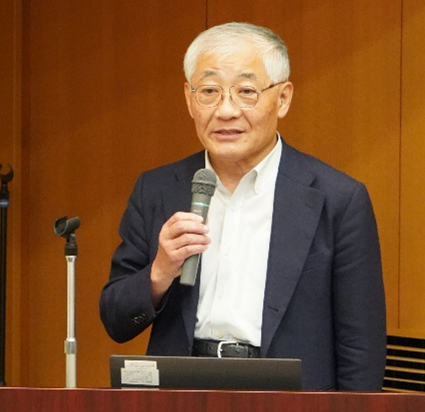
Executive Director Koike |
There was an active discussion session, with comments from H.E. Hani Sewilam and Dr. Pema Gyamtsho, among others, in response to the presentations.
Finally, Executive Director KOIKE Toshio wrapped up the presentation session by expressing his appreciation for the visitors.
ICHARM will continue to offer research presentations such as this for senior officials and others from Japan and abroad, aiming to mainstream disaster risk reduction worldwide.
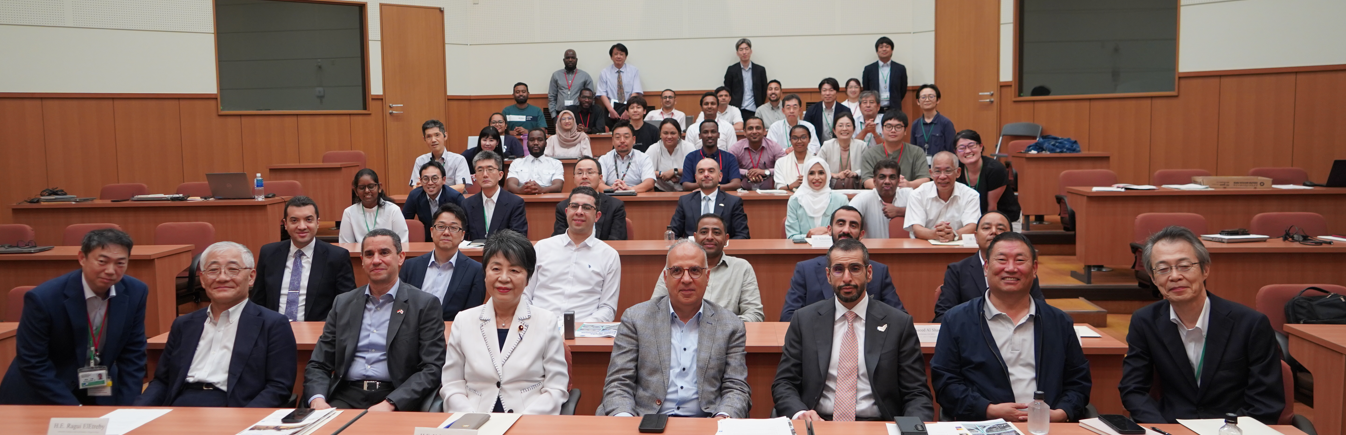 |
Senior officials with other symposium participants
(Front row, from left: Chief Researcher Kuribayashi, Executive Director Koike, Ambassador ElEtreby, Special Envoy Kamikawa, Minister Sewilam, Assistant Minister Balalaa, Director General Gyamtsho, and PWRI President Fujita)
|