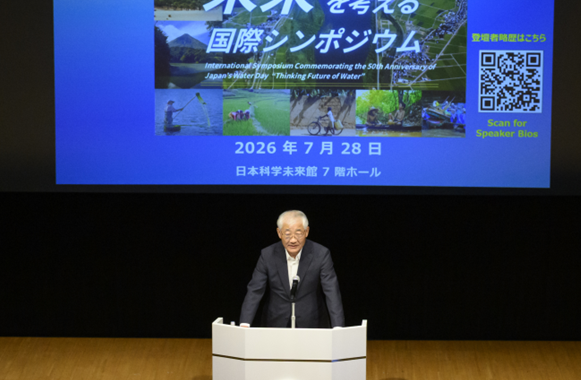
The International Symposium Commemorating the 50th Anniversary of Japan’s Water Day, “Thinking Future of Water,” was held on July 28, 2026, at Miraikan Hall of the National Museum of Emerging Science and Innovation in Tokyo, Japan, with His Majesty the Emperor in attendance. The symposium – marking a significant milestone, the 50th anniversary of Japan’s Water Day and Water Week – was also planned in anticipation of the 2026 United Nations Water Conference (UNWC) to be held in December. Its purpose was to discuss approaches to integrated water management encompassing flood management, water utilization, and environmental conservation, in order to reduce water-related risks arising from increasingly severe climate change while promoting the development of sustainable societies worldwide. Executive Director KOIKE Toshio participated in the event as the chair of the Water Week organizing committee.
Following the opening remarks by Dr. Han Seung-soo, the chair of the High-Level Experts and Leaders Panel on Water and Disasters (HELP) and a former prime minister of the Republic of Korea, Koike spoke alongside other organizers, including KANEKO Yasushi, Minister of Land, Infrastructure, Transport and Tourism of Japan, and KOIKE Yuriko, Governor of Tokyo. Congratulatory remarks were also given by KAMIKAWA Yoko, Special Envoy of the Prime Minister for the 2026 UN Water Conference. In his speech, Koike introduced the evolution of basin management concepts from “sound water cycle” and “River Basin Disaster Resilience and Sustainability by All” to the broader framework of “Integrated River Basin Management for All.” He also presented the draft declaration entitled “The Water Future We Envision,” scheduled for delivery at the Water Day gathering on July 31.
The keynote session began with a presentation by KANDA Masato, the President of the Asian Development Bank. He outlined the bank’s achievements and future plans in financing climate change adaptation projects, the establishment of funds supported by Japan, and collaboration with other development banks. Dr. Hani Sewilam, the Egyptian Minister of Water Resources and Irrigation, spoke on the state of water resources in Egypt, highlighting examples of advanced water-related risk management technologies utilizing AI and other innovations. He also expressed his commitment to the 2026 UNWC Interactive Dialogue C, “Water for Planet,” for which Japan and Egypt serve as co-chairs. Abdulla Balalaa, Assistant Minister of Foreign Affairs for Energy Sustainabe Affairs of the United Arab Emirates, spoke as a representative of the UNWC host country, expressing his expectations for the creation of sustainable and measurable actions as well as new partnerships through the conference. Dr. MUSHIAKE Katsumi, a professor emeritus at the University of Tokyo, discussed the concept of “Integrated River Basin Management for All,” noting that river basin management should be regarded as an integral part of national land management. He stressed the importance of respecting local characteristics and diversity, Cross-sector collaboration, and maintaining the flexibility to adapt and learn while implementing policies.
A high-level panel discussion was also held, moderated by HIROKI Kenzo, a professor emeritus at the National Graduate Institute for Policy Studies, who is also the HELP Coordinator. Panelists included Saroj Kumar Jha, the Global Director for the World Bank Group’s Water Department; SUNAMI Atsushi, the President of the Sasakawa Peace Foundation; Dr. Pema Gyamtsho, the Director General of the International Centre for Integrated Mountain Development (ICIMOD); and NODA Yumiko, the Vice Chair and the Chair of the Environment Committee at Keidanren (Japan Business Federation).
Throughout the symposium, participants shared the view that water forms the foundation of employment, economic prosperity, and peace. In addressing challenges such as glacier melt caused by climate change, growing water demand, and the need for environmental improvement, including water quality enhancement, speakers emphasized the necessity of comprehensive river-basin water management. They further highlighted the importance of public-private partnerships, the participation of women, technological innovation, data-driven decision-making, and international cooperation in achieving these goals.
ICHARM hopes that the outcomes of this symposium will be shared with the international community through forthcoming conferences and other forums, generating synergies that will contribute to enhancing global efforts to address water-related challenges, including discussions and actions toward the post-2030 agenda.
 |
(Courtesy of the Organizing Secretariat) |