

 |
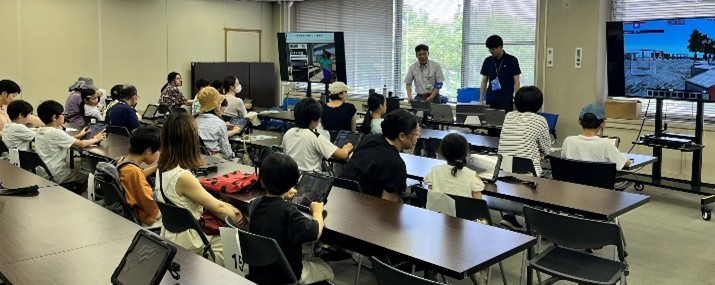
| Senior Researcher DENDA Masatoshi and Researcher YAMASHITA Daiki (standing in the back) explaining the activity to participants. |
Tsukuba City in Ibaraki Prefecture, Japan, where ICHARM is based, held the Tsukuba Chibikko Hakase 2026 from July 18 to August 31. The “Chibikko Hakase (Young Polymath)” program is an annual summer event in which elementary and junior‑high school students—not only local students but also those from across Japan—are invited to visit various research institutes, companies, and cultural facilities in Tsukuba to learn while having fun. Participants collect points on a dedicated website using their smartphones or other devices as they aim to earn the title of “Top Tsukuba Chibikko Hakase.” This summer, a total of 41 research institutes, companies, and cultural facilities in Tsukuba took part in the program.
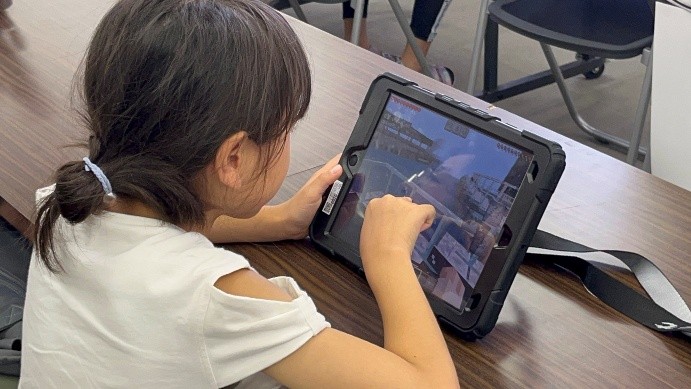 |
| Participants expericing how to evacuate while enjoying the activity. |
Among the 41 participating entities, the National Institute for Land and Infrastructure Management (NILIM) and the Public Works Research Institute (PWRI) jointly held the event “Tsukuba Chibikko Hakase 2026: NILIM–PWRI Open House.” on July 31, 2026. As a part of PWRI, ICHARM organized a hands‑on activity titled “Experience Urban Flooding with Minecraft.” The activity was conducted in six sessions, each lasting 30 minutes, with up to 13 families per session. A total of 68 families (110 participants) took part. This time, participants used a newly developed virtual space that reproduces the area around Akihabara Station in Tokyo to experience flood evacuation through the Minecraft‑based Virtual Flood Experience System (VFES). First, we let participants freely walk around the virtual space, so they could enjoy the feeling of actually being in the city while also getting used to the basic controls of Minecraft. After that, they moved to the another virtual space around Akihabara Station, where, under a scenario of the Ara River, the major river closest to Akihabara, overflowing and flooding the Akihabara area, participants could experience evacuation from flooding using a Minecraft-based VFES.
In each session, Senior Researcher DENDA Masatoshi first explained an overview of the Ara River. Participants were then instructed to carry out two rounds of flood evacuation exercises using a scenario in which flooding from the Ara River flows into the Akihabara area. In the first round, participants were intentionally given no prior information and asked to evacuate freely. Many wandered around the starting point, unsure of where to go. After being informed about the underpass connecting the east and west sides of the station and the direction of higher ground (toward Kanda Myoujin, a nearby shrine), many participants were able to evacuate successfully in the second round, choosing safer routes and avoiding hazardous locations. These results suggest that experiencing failure can motivate participants to improve in subsequent attempts, thereby enhancing the learning effect.
Going forward, ICHARM will examine the potential applications of the Virtual Flood Experience System in disaster‑education programs, drawing on the valuable data obtained through opportunities such as this.
Tsukuba City: Tsukuba Chibikko Hakase 2026 (Japanese only)
https://www.city.tsukuba.lg.jp/kosodate/oshirase/chibikko-hakase/index.html