

 |
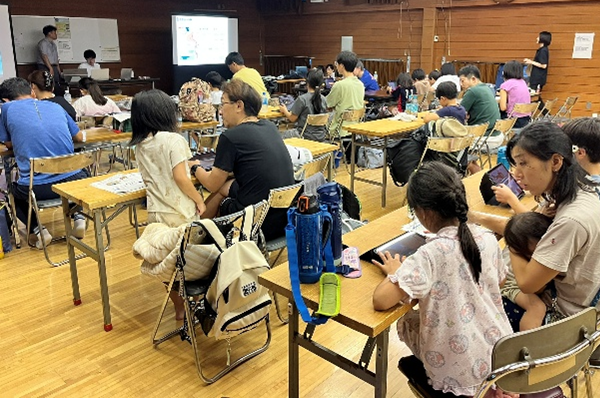
| Scene of the venue |
On August 8 and 9, 2026, Joso City in Ibaraki Prefecture, Japan, hosted the Bosai Camp, a disaster awareness program, using Mitsukaido Asunaro-no-Sato as the main venue. The event is held annually for Joso families with elementary school students. This year, 43 participants from 15 households (18 adults and 25 children) took part. As part of the program, ICHARM organized a disaster awareness activity in the late afternoon of the 8th, during which participants experienced flood disasters using the Minecraft-based Virtual Flood Experience System (VFES) developed by ICHARM.
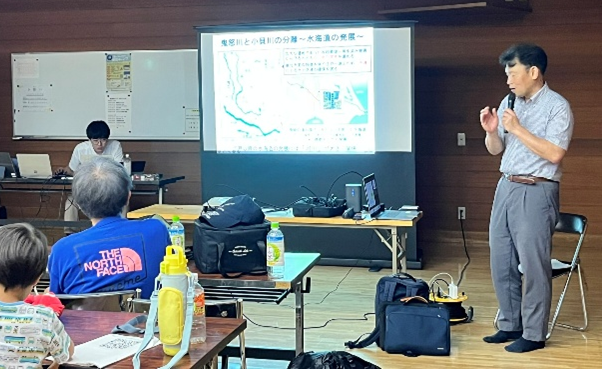 |
| Senior Researcher DENDA Masatoshi and Researcher YAMASHITA Daiki (standing in the back) explaining the activity to participants. |
The virtual space used in this system for this activity was an improved version created by students at Ibaraki Prefectural Mitsukaido First High School Affiliated Junior High School (Joso City) during last year’s inquiry‑based learning program instructed by ICHARM researchers. It accurately reproduces key locations such as Mitsukaido Station, supermarkets, and local schools.
Participants first received brief lectures from Senior Researcher DENDA Masatoshi and Researcher YAMASHITA Daiki about topics such as the Tone River Eastward Diversion, the topography and flood history of Joso City, how to read hazard maps, and the importance of checking water levels and rainfall in advance during heavy rain. After that, they tried the VFES using the tablets distributed to them.
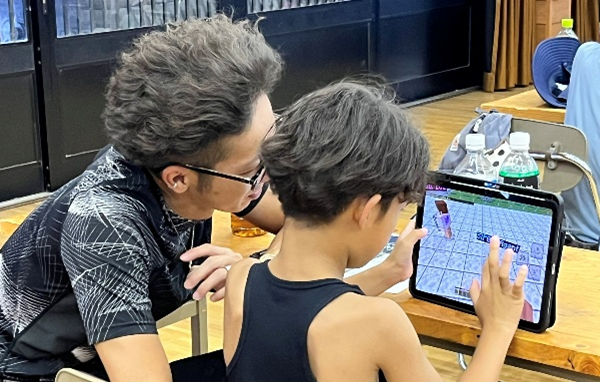 |
| Participants expericing how to evacuate while enjoying the activity. |
Participants experienced virtual flood conditions twice. In the first round, they were instructed to evacuate without being given any prior information, such as evacuation sites. In the second round, they evacuated after being informed about local topographic features and the appropriate directions to flee. While some participants wandered around the starting point during the first attempt, many were able to evacuate toward higher ground in the second attempt. This activity provided an excellent opportunity for participants to learn practical lessons for emergencies by experiencing both failure and success in virtual flood situations.
In the post‑event survey, participants shared positive feedback such as “It was fun to think about where to evacuate during a flood,” “I’m glad I learned what actions to take in a flood,” and “Although it was completely new for adults like myself, children who are familiar with Minecraft seemed to find it easy to understand.”
Going forward, ICHARM will examine the potential applications of the Virtual Flood Experience System in disaster‑education programs, drawing on the valuable data obtained through opportunities such as this.
Finally, ICHARM expresses its sincere appreciation to the staff of the Joso City Disaster Risk Management Division for making this opportunity possible.